
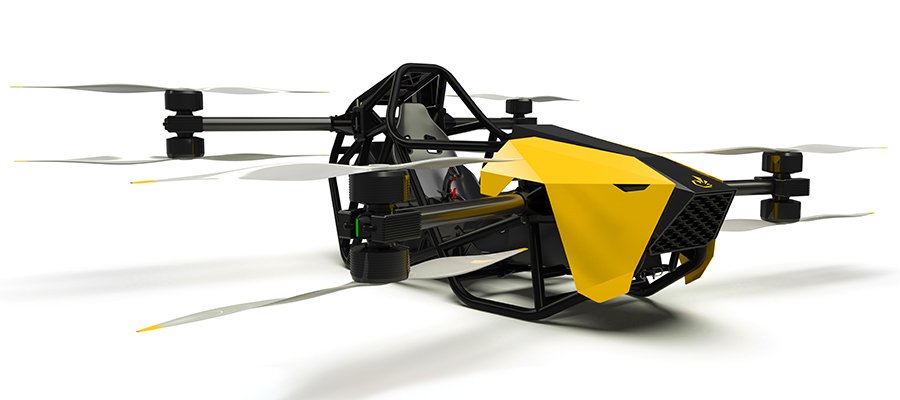
What happens when you take the same basic design template as the Jetson ONE, fit larger propellers, increase the battery capacity, and remove the constraints that come with trying to remain within ultralight regulations?
You get something rather interesting: the Hornet H1.
At first glance, the Hornet H1 looks like a larger and arguably more substantial version of the coaxial quadcopter personal eVTOL configuration popularised by the Jetson ONE. Both aircraft use an open-frame structure, a single-seat cockpit and multiple electric motors arranged around the pilot.
But look beyond the superficial similarities and the philosophy behind the two aircraft is quite different.
The Jetson ONE has been designed around extreme lightness. The Hornet H1, on the other hand, accepts considerably more weight in exchange for a larger battery, greater payload capability, larger propellers and potentially much longer flight times.
So is the Hornet simply a scaled-up Jetson ONE, or does increasing the size fundamentally change what this type of personal eVTOL can do?
Moving Beyond the Ultralight Philosophy
One of the reasons the Jetson ONE attracted so much attention was its attempt to remain within the limits of the FAA’s Part 103 ultralight regulations in the United States.
That places enormous pressure on aircraft weight.
The result is a remarkably compact machine, but it also inevitably restricts how much battery, structure and payload can be carried.
The Hornet H1 takes a very different approach.
Rather than designing around those strict ultralight weight limits, the Hornet becomes a significantly larger aircraft. The increase in size comes with a substantial weight penalty, but it also opens up possibilities that are difficult to achieve when every kilogram matters.
Perhaps the most obvious example is pilot weight.
The Hornet H1 is designed for a pilot weighing up to around 120 kg. That makes the aircraft accessible to a considerably broader range of users than many ultralight personal eVTOL designs.
A Much Heavier Aircraft
The Hornet H1 weighs approximately 280 kg with its batteries installed, while its maximum take-off weight is around 400 kg.
That puts it in an entirely different weight category from the Jetson ONE.
But simply saying that the Hornet is heavier doesn’t tell the whole story.
A larger aircraft can carry larger rotors. And in vertical flight, rotor area is extremely important.
Increasing the total rotor disc area reduces disc loading — the amount of aircraft weight supported by each unit of rotor area.
Lower disc loading generally reduces the induced power required to hover.
This is one reason why simply comparing aircraft weight can be misleading. A heavier VTOL aircraft with substantially more rotor area does not necessarily require proportionally more power to remain airborne.
In ideal momentum theory, induced hover power increases approximately with the weight raised to the power of 3/2 and decreases with the square root of total rotor disc area.
So the Hornet’s larger propellers potentially recover some of the efficiency lost through its additional mass.
Bigger Battery, Longer Endurance
The other major advantage of abandoning the ultralight weight restriction is obvious: battery capacity.
The Hornet H1 claims an endurance of up to approximately 30 minutes.
For a small multicopter-style personal eVTOL, that is significant.
The Jetson ONE, by comparison, is generally associated with flight times of around 20 minutes.
Ten additional minutes might not sound transformational in the context of conventional aviation, but for this category of aircraft it represents a roughly 50% increase in available flight time.
And that extra endurance fundamentally changes how useful the aircraft could be.
A 15- or 20-minute aircraft is largely recreational. Once endurance begins approaching 30 minutes, the possibility of short practical journeys becomes much more credible.
Up to 120 km/h
The Hornet H1 also has a claimed maximum speed of approximately 120 km/h.
Again, that puts it ahead of the Jetson ONE’s roughly 100 km/h-class performance.
But speed isn’t necessarily the most important advantage.
Multicopter eVTOLs are not aerodynamically efficient aircraft in forward flight. Unlike a conventional aeroplane, there is no large fixed wing generating lift efficiently once the vehicle gets moving.
The rotors must continue supporting the aircraft throughout the flight.
That means increasing speed can quickly increase the aerodynamic power required, particularly with an open-frame aircraft carrying a pilot directly in the airflow.
The Hornet therefore remains fundamentally a short-range VTOL aircraft rather than a long-distance electric aeroplane.
Eight Motors and Coaxial Propellers
Like the Jetson ONE, the Hornet uses a coaxial multicopter configuration.
Multiple electric motors are positioned around the airframe, providing vertical lift without requiring tilting wings, variable-pitch helicopter rotors or complex mechanical transmissions.
There are some important advantages to this architecture.
It is mechanically simple.
Electric motors can respond extremely quickly to control inputs.
And because there are several independent propulsion units, the aircraft can potentially tolerate certain propulsion failures while retaining some degree of controllability.
The disadvantage is efficiency.
Placing rotors coaxially means one rotor operates partially in the disturbed airflow of another. There are therefore aerodynamic penalties compared with giving every rotor completely undisturbed air.
But packaging eight rotors around a compact aircraft while keeping the overall footprint manageable makes the compromise attractive for personal eVTOL designs.
A Larger Footprint
The Hornet H1 measures approximately 4 metres by 4 metres, with a height of around 1.165 metres.
That is a substantial machine.
For comparison, one of the Jetson ONE’s strengths is just how compact it is.
The Hornet therefore gives away some of the storage and transport advantages associated with the smallest personal eVTOLs.
However, its structure can be folded.
That is an important feature because an aircraft of this type must ultimately operate within the realities of road transport, storage and hangar space.
A 4-metre-wide aircraft is inconvenient.
A folding 4-metre-wide aircraft becomes considerably more practical.
Remote Piloting
Another particularly interesting aspect of the Hornet is that it is not necessarily limited to carrying a pilot.
The aircraft is designed with remote operation capability, with a reported ground-station communication range of up to approximately 20 km.
That dramatically broadens the potential applications of the platform.
Remove the pilot and the aircraft stops being simply a recreational personal eVTOL.
It potentially becomes a remotely operated cargo aircraft, surveillance platform or specialist unmanned vehicle.
And this is where the greater payload capacity of the Hornet becomes especially interesting.
An aircraft capable of carrying a 120 kg human can potentially carry a substantial payload when the seat is not occupied.
A More Substantial Cockpit
The increase in aircraft size also allows the Hornet to offer something that extremely lightweight eVTOLs struggle with: a more substantial cockpit environment.
The pilot sits inside a protective tubular structure rather than simply being perched on an ultra-minimal flying frame.
There is still very little separating the pilot from the outside environment, but the overall structure has the appearance of something closer to a tiny aircraft than an airborne seat surrounded by propellers.
For some buyers, that psychological difference may be important.
Personal eVTOLs will eventually need to convince ordinary people that they are machines they can actually trust themselves to fly.
Performance alone will not achieve that.
The Regulatory Problem
The Hornet’s size and weight bring advantages, but they also remove one of the biggest benefits enjoyed by aircraft such as the Jetson ONE.
It is no longer a machine that can simply rely on the regulatory freedoms associated with very lightweight ultralight aircraft.
That potentially means aircraft certification, pilot licensing requirements and operational restrictions become much more important.
And that is perhaps the biggest trade-off in the entire design.
Jetson has designed around regulation.
Hornet has designed around capability.
Neither approach is necessarily right or wrong, but they lead to fundamentally different products.
The Price: Around $150,000
And then we arrive at perhaps the most important question for many potential buyers: price.
The Hornet H1 is expected to cost around $150,000.
That places it firmly in premium recreational-aircraft territory.
It is considerably more expensive than many people would associate with a small personal flying machine, although personal eVTOL prices in general have been steadily moving upward as manufacturers move from prototypes toward commercially viable aircraft.
At $150,000, the Hornet cannot simply be judged as an interesting engineering experiment.
Buyers will understandably expect serious capability for that amount of money.
And that makes the claimed 30-minute endurance, 120 km/h speed, greater payload capacity and remote-operation capability particularly important.
When Can You Buy One?
The other issue is availability.
The Hornet H1 remains a developing aircraft rather than a mature product that buyers can simply order today and expect immediate delivery.
Current development plans indicate commercial availability is expected after 2028.
That means the specifications should still be treated as development targets rather than the final performance of a certified production aircraft.
As with almost every emerging eVTOL manufacturer, turning an impressive prototype into a repeatable, safe and commercially supported product will be the real challenge.
So, Is the Hornet H1 Worth It?
That ultimately depends on what you want from a personal eVTOL.
If the goal is to create the smallest and lightest possible recreational aircraft, the Jetson ONE philosophy remains enormously attractive.
But the Hornet asks a different question.
What happens if you stop obsessing over minimum weight and allow the aircraft to become bigger?
You can carry a heavier pilot.
You can install a larger battery.
You can use larger propellers.
You can potentially stay airborne for around 30 minutes.
And you can turn the same basic aircraft into a remotely operated platform when a pilot isn’t required.
The cost is increased weight, a larger footprint, greater regulatory complexity and a price of around $150,000.
So although the Hornet H1 might initially look like little more than a larger Jetson ONE, that additional size actually represents a very different design philosophy.
The Jetson ONE asks:
How small and light can a personal eVTOL become?
The Hornet H1 asks:
What could the same basic concept do if we made it bigger?
And that may ultimately prove to be the more interesting question.