
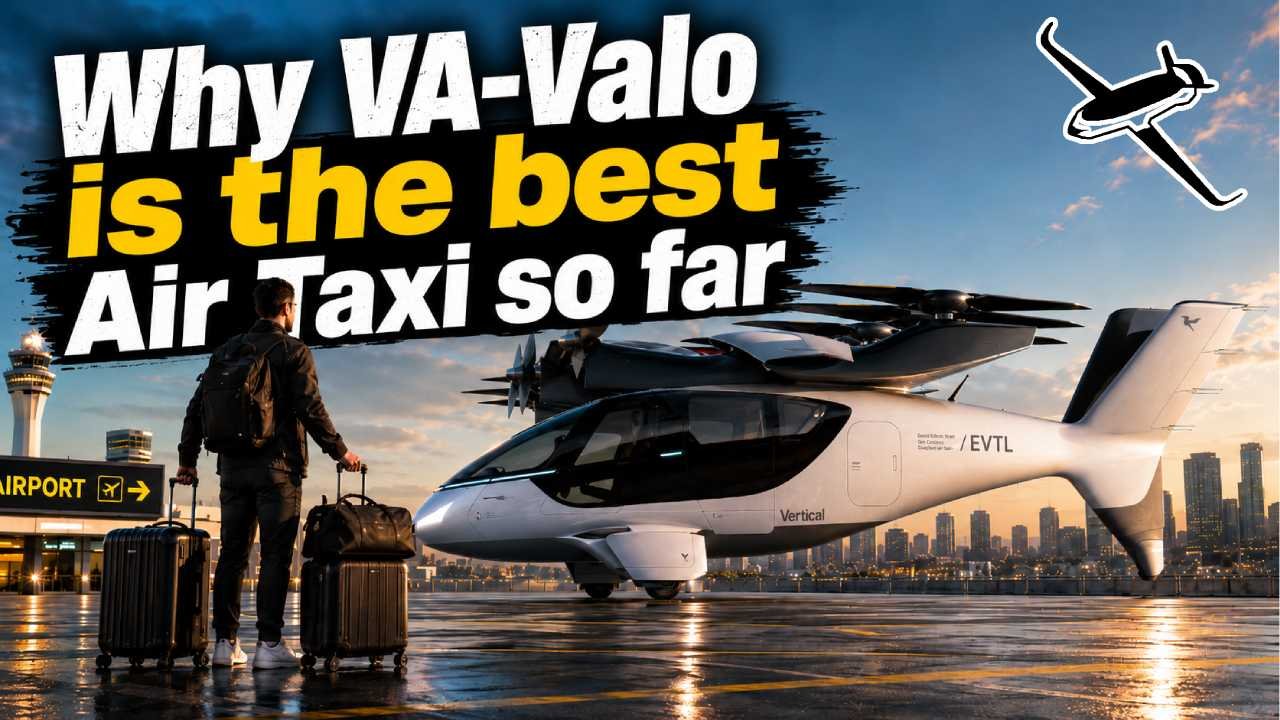
Most electric air taxis share the same overlooked flaw: they treat passengers like premium cargo, while actual cargo is treated as an afterthought.
That might sound like a small detail, but it matters. If someone is flying from an international airport to a city center, they are probably not traveling with just a laptop bag. They have cabin luggage, checked bags, and sometimes even more. In that context, an air taxi that can carry people but not their baggage is not truly solving the airport transfer problem.
That is where Vertical Aerospace’s VA-Valo begins to look different.
While many leading eVTOL designs focus on sleek styling, short city hops, and passenger capacity, the Valo appears to be aimed at something more practical: real-world travel. With a claimed payload capacity of 550 kilograms and a dedicated cargo bay designed to accommodate six cabin bags and six checked bags, Vertical is positioning the Valo as more than just another futuristic aircraft. It is presenting it as a utility vehicle for actual travelers.
And with Vertical also discussing a hybrid-electric variant targeting a range of up to 1,000 miles, the Valo could represent a major shift in how the air taxi market thinks about practicality, range, and commercial usefulness.
From Early Prototypes to a New Aircraft Philosophy
Vertical Aerospace began its journey in 2016, and its early aircraft looked very different from the Valo concept seen today. Between 2016 and 2019, the company focused heavily on pure quadcopter designs, including the uncrewed VA-X1 and the VA-X2 Seraph.
The Seraph was an important milestone because it demonstrated that a heavy-lift electric aircraft could carry a 250-kilogram load. However, pure quadcopters have limitations. They can be effective for vertical lift, but they are not ideal for efficiency, speed, or longer-range travel.
To compete seriously in urban air mobility, Vertical needed a more advanced architecture. Rather than copying the fully tilting-motor approach used by companies like Joby, or the lift-and-cruise layout seen in designs from companies such as Wisk, Vertical chose a hybrid path. Its VX4 prototype used four tilting rotors for efficient forward flight, combined with four lift-only propellers for vertical takeoff and landing.
That architecture allowed Vertical to explore a middle ground between mechanical complexity and aerodynamic efficiency.
The Crash That Forced a Rethink
The VX4 prototype was an important stepping stone, but its development was not without setbacks.
During an engine-out test flight in August 2023, a propeller blade detached. The resulting vibration caused major structural damage and forced the aircraft into a hard landing. For any startup in the aviation sector, an incident like that can be devastating. Certification timelines, investor confidence, engineering assumptions, and public trust can all be affected.
But for Vertical, the incident appears to have triggered a deeper redesign rather than a retreat.
The company investigated the failure, reassessed the aircraft architecture, and used the lessons from the VX4 program to shape what would become the VA-Valo. In that sense, the crash became a harsh but valuable engineering crucible. It forced Vertical to build a more robust aircraft philosophy around safety, structure, certification, and real-world durability.
What Makes the VA-Valo Different?
At first glance, the Valo resembles the VX4 prototype. But the differences are important.
The aircraft features a more curved nose and a shorter fuselage, helping reduce wetted surface area by around 15 percent. In electric aviation, that matters. Battery-powered aircraft must fight for every percentage point of efficiency, and reducing drag can directly improve range and performance.
Vertical also changed the landing gear arrangement. The VX4’s tricycle landing gear has been replaced with a more rugged tailwheel configuration. The front wheels are housed in dedicated sponsons, and a ventral fin has been added near the tail to improve directional stability during complex flight transitions.
One of the most important changes is hidden under the cabin floor. In the VX4 prototype, battery packs were distributed throughout the airframe. In the Valo, all eight liquid-cooled battery packs are mounted beneath the floorboards. That choice opens up more cabin volume and lowers the center of gravity, both of which are crucial for passenger comfort, safety, and aircraft handling.
Vertical has also isolated the pilot’s compartment from the passenger cabin. For a high-capacity commercial vehicle, this is not just a luxury feature. It reflects airline-style thinking, where the flight deck must be protected, controlled, and free from distraction.
The Cargo Bay Could Be the Real Breakthrough
The Valo’s most practical advantage may not be its rotors, batteries, or aerodynamic refinements. It may be its cargo bay.
Urban air mobility is often marketed as a premium time-saving service for airport transfers. But airport passengers travel with baggage. If an eVTOL can only carry passengers comfortably while struggling to accommodate luggage, then its real-world usefulness is limited.
Vertical’s decision to engineer a dedicated baggage solution changes the equation. A payload capacity of 550 kilograms, combined with space for six cabin bags and six checked bags, makes the Valo feel less like a technology demonstrator and more like a vehicle designed around an actual commercial route.
That could be a major advantage over aircraft that are optimized primarily for short passenger hops without much thought for luggage.
Certification and the Long Game
Vertical Aerospace is not just trying to build an eye-catching aircraft. It is trying to meet Europe’s demanding SC-VTOL certification standards.
That is a difficult path, but it could also become one of the company’s biggest strengths. Commercial aviation rewards reliability, redundancy, and discipline. Vertical’s focus on airliner-grade safety targets, including extremely low acceptable failure rates, suggests the company is thinking beyond demonstrations and toward real operations.
The company’s testing program also reflects that mindset. Battery drop tests, structural validation, and strict regulatory oversight may not generate the flashiest headlines, but they are essential if eVTOL aircraft are ever going to move from prototypes to passenger service.
The VX4 prototype also continues to play a role in this journey. Its piloted transition testing has helped prove key parts of Vertical’s tiltrotor flight architecture and has given the company important data for the next stage of development.
Why the VA-Valo Matters
The air taxi industry has no shortage of futuristic aircraft. The problem is that many of them still feel like machines designed for concept videos rather than real travelers.
The VA-Valo stands out because it addresses the practical details that passengers, operators, and regulators will care about. It offers more payload, a real baggage solution, improved packaging, a redesigned airframe, and a certification-focused development strategy.
That does not mean success is guaranteed. Vertical still has to prove the aircraft through testing, certification, production, and commercial deployment. But the Valo shows that the company is not simply chasing the loudest marketing story. It is trying to build an air taxi that works in the real world.
And in the long run, that may be what separates the winners from the prototypes.
The future of urban air mobility will not be decided by which aircraft looks the most futuristic. It will be decided by which aircraft can safely, reliably, and practically move people where they actually need to go—with their luggage included.
That is why the VA-Valo may be one of the most important air taxis developed so far.