
For most of the last century, small airships have occupied an awkward space in aviation. Too light to handle wind, too limited to carry meaningful payloads, and too constrained by regulation to be useful, they were often dismissed as novelties or science projects. Large airships, on the other hand, have always made sense. Today’s Airlander, Flying Whale, Pathfinder, and Clipper designs are enormous vehicles with payloads measured in tens of tonnes, optimized for efficiency and stability at scale.
So why is there suddenly renewed interest in small airships—aircraft capable of lifting not tonnes, but tens of kilograms?
The answer is that technology and regulation have finally caught up.
Why Big Airships Always Had the Advantage
The fundamental reason large airships work so well is the square–cube law. As an airship increases in size, its volume—and therefore its lift—grows faster than its surface area. This provides proportionally more lift for less drag, while also reducing the aircraft’s sensitivity to wind. Simply put, very large airships are inherently more stable and efficient than small ones.
That’s why modern heavy-lift airships are the size of football stadiums. They’re stable, energy-efficient, and capable of carrying massive payloads over long distances. Small airships, by contrast, have historically been “pushovers”: easily affected by weather and unable to carry enough weight to justify their complexity.
For decades, this physics reality made small airships a poor engineering tradeoff.
The Regulatory Breakthrough That Changed Everything
One of the most important enablers for small airships isn’t hardware at all—it’s regulation.
For years, operating a drone-sized airship beyond visual line of sight was a legal nightmare. Every mission required special waivers, severely limiting commercial viability. That changed with the introduction of FAA Part 108, first announced in 2025 and updated in January 2026.
Part 108 standardized Beyond Visual Line of Sight (BVLOS) operations for aircraft weighing up to 1,320 pounds. Instead of requesting individual approvals for every flight, operators now have a consistent framework for routine long-distance, autonomous missions. The rule also introduced “shielded operations,” allowing aircraft to fly close to infrastructure such as pipelines and powerlines—exactly the type of slow, precise work airships excel at.
This single regulatory shift turned small airships from experimental curiosities into legitimate commercial tools.
Kelluu: Adaptive Design for Harsh Environments
A compelling example of this new generation is the Kelluu airship from Finland. Roughly 11 to 12 meters long and about two meters in diameter—comparable in size to a city bus—Kelluu has been tested in Arctic conditions and designed to operate in temperatures as low as minus 30 degrees Celsius.
One of its standout features is a reflective upper coating that acts as a thermal buffer. During daylight hours, sunlight can cause internal gas pressure to rise. At night, rapid heat loss becomes a problem. The reflective surface moderates both extremes, improving energy efficiency and flight stability during long missions.
Kelluu uses hydrogen as a lifting gas, paired with patented safety systems to manage risk. Its mission profile includes border surveillance, wildfire detection, environmental monitoring, and mapping—applications where long endurance and low-speed loitering matter more than speed.
Perhaps most interesting is Kelluu’s patented variable-shape design. By adjusting internal stiffeners, the airship can change its geometry in flight, becoming shorter and wider for increased lift or longer and slimmer to reduce drag. Rather than fighting the limitations of small size, Kelluu adapts its shape to the mission.
Phoenix UAV and the Idea of “Breathing” for Propulsion
Another radical rethink comes from the Phoenix UAV, a 15-meter-long ultra-long-endurance aircraft designed to function as a pseudo-satellite. Phoenix does not rely on propellers for propulsion at all.
Instead, it repeatedly transitions between lighter-than-air and heavier-than-air flight. The vehicle contains roughly 120 cubic meters of helium for buoyancy, along with an internal air bladder. Pumps draw in and compress outside air, increasing the aircraft’s weight without changing its volume, causing it to descend. When the compressed air is released, buoyancy returns and the aircraft climbs.
By carefully controlling ascent, descent, and aerodynamic lift, Phoenix converts vertical motion into forward movement. The concept is borrowed from underwater gliders and adapted for the sky. In simple terms, the aircraft “breathes” to move. Solar panels on its fins provide the energy needed to compress air, enabling extremely long endurance without traditional engines.
Fuel Cells: Power and Ballast in One System
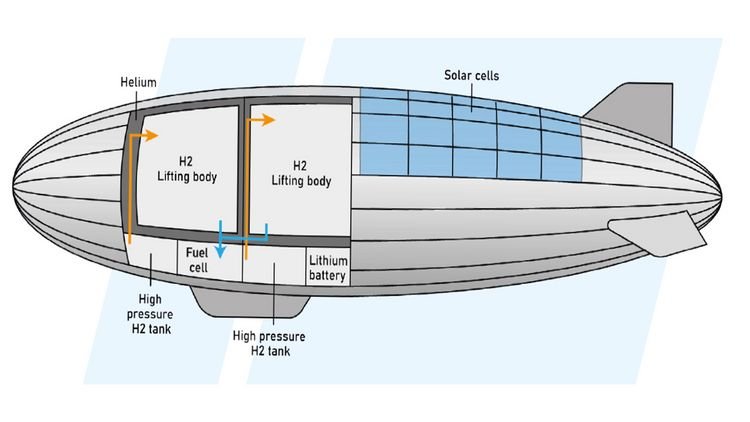
Weight management has always been one of the hardest problems for airships. Burning fuel makes an airship lighter, which increases buoyancy and complicates landing and altitude control. Fuel cells offer an elegant solution.
In reversible fuel-cell systems, stored water can be electrolyzed into hydrogen when additional buoyancy is needed, with oxygen vented overboard. When it’s time to descend or land, hydrogen is recombined with oxygen from the atmosphere to produce water again. For every kilogram of hydrogen consumed, roughly nine kilograms of water are created—providing instant ballast while also generating electrical power.
Combined with solar panels integrated into the airship’s skin, fuel cells are an almost perfect match for long-endurance, autonomous airships.
Cloudline and Practical Small-Airship Operations
Cloudline, a South African startup, is applying these ideas to real-world logistics. Its autonomous, solar-powered airship is designed for last-mile delivery in remote and infrastructure-poor regions. The production model measures 18.2 meters long and 5.2 meters wide—large enough for stability, but small enough to operate under modern UAV regulations.
Cloudline’s mission set includes medical logistics, infrastructure inspection, wildlife conservation, disaster relief, and temporary communications coverage. One of its most distinctive features is a yaw rotor mounted on the tail. While hull-mounted motors provide forward thrust and lift, the tail rotor enables precise low-speed maneuvering, allowing the airship to turn almost in place.
Current models carry around 20 kilograms of payload. With solar power, the aircraft can remain aloft continuously during daylight, while battery power alone provides roughly 10 hours of endurance and a range of up to 400 kilometers at a cruise speed of about 40 kilometers per hour. As of early 2026, Cloudline has transitioned from experimental prototypes to production-ready designs.
From Small Airships to the Edge of Space
At the upper end of the small-airship spectrum are High Altitude Platform Systems (HAPS). These aircraft operate in the stratosphere, carrying payloads of around 250 kilograms while generating roughly 10 kilowatts of solar power. Unlike balloons, they can station-keep. Unlike fixed-wing UAVs, they can carry large payloads for months at a time.
Typical designs are around 65 meters long and capable of covering regions roughly 100 miles across. Advanced laminated hull materials dramatically reduce helium leakage while surviving prolonged exposure to UV radiation and ozone.
Beyond these platforms, companies such as AT2 Aerospace and projects like Solar Airship One are pushing toward even larger hydrogen-powered and solar-driven airships—topics deserving of their own deep dives.
The Takeaway
Small airships are no longer novelties. Smarter aerodynamics, adaptive structures, novel propulsion concepts, solar power, fuel cells, and—crucially—sensible regulation have reshaped what’s possible. Payloads in the 10 to 100 kilogram range are now practical, commercially viable, and increasingly attractive for missions where endurance, efficiency, and precision matter more than speed.
After decades of false starts, small airships are finally becoming serious machines.