
Electric aviation is often described simply as the process of replacing an internal-combustion engine or turbine with batteries and electric motors.
But that is only part of the story.
One of the most interesting things about electric aviation is that it is allowing engineers to reconsider aircraft technologies that were previously too complicated, too inefficient or simply impractical.
Compact electric motors can be positioned almost anywhere on an aircraft. Power can be distributed electrically without gearboxes or long mechanical driveshafts. Propellers can become generators. Lift can be distributed across an entire wing.
As a result, some aviation ideas that have existed for decades are suddenly becoming relevant again.
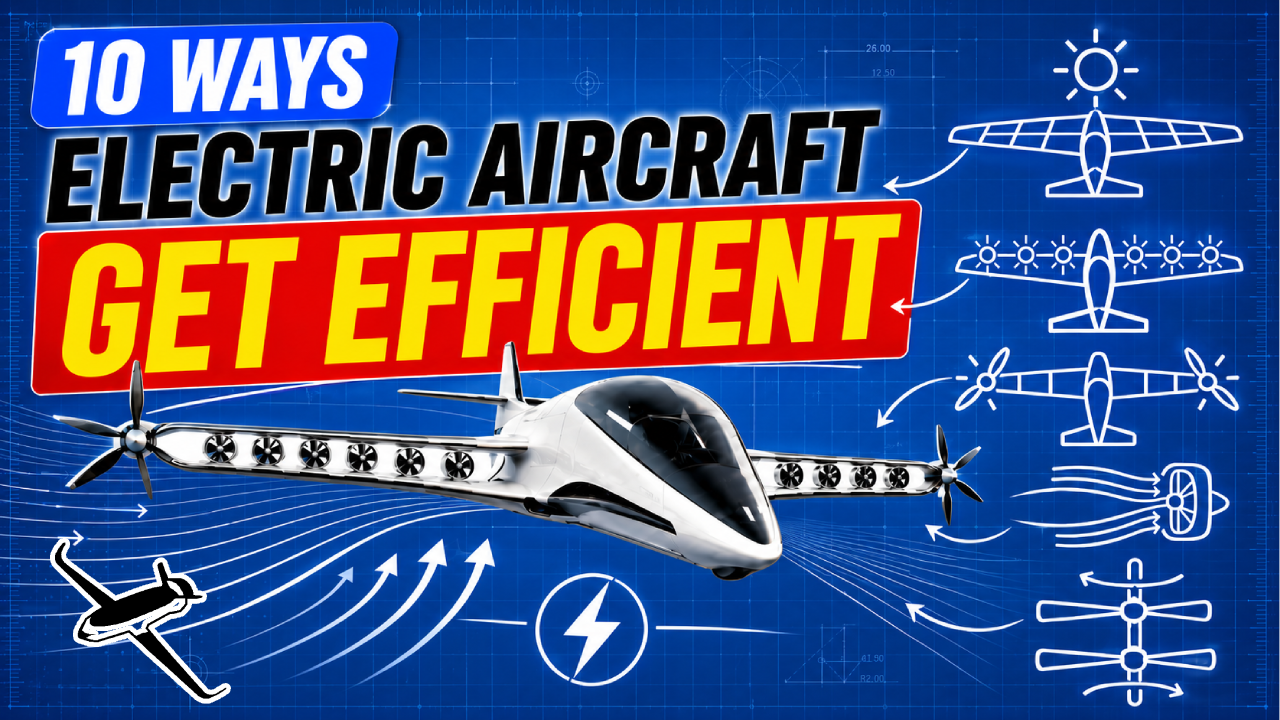
Here are 10 aviation technologies that are being revived, accelerated or enabled by electric aviation.
1. Solar Power Generation
Perhaps the most obvious example is solar-electric flight.
Electric aviation has made it possible for some aircraft to generate part — or even all — of the energy they require while flying.
Solar cells can be integrated into large wings and lightweight aircraft structures, continuously supplying electricity to the propulsion system or recharging batteries.
The most famous example is Solar Impulse, which demonstrated that an aircraft could fly using solar energy alone.
High-altitude platforms such as Sceye take the idea even further. At very high altitude, where aircraft can remain above much of the weather, solar power can potentially support extremely long endurance missions.
Aircraft such as SolarStratos and the Sunseeker Duo also demonstrate how solar energy can supplement stored electrical energy and extend endurance.
The concept works particularly well with electric propulsion because electricity generated by the solar cells can be fed directly into the aircraft’s electrical system.
The efficiency win: In the right application, solar energy can dramatically extend endurance and potentially remove the requirement for conventional fuel entirely.
2. Fan-in-Wing Propulsion
Another technology getting a new lease of life is the fan-in-wing configuration.
Electric motors are relatively compact and can be distributed around an aircraft far more easily than conventional engines.
That makes it possible to install multiple lift fans directly inside the wings.
During vertical take-off, doors or panels in the wing open and the fans provide vertical thrust.
Once sufficient forward speed has been achieved, the lift fans are shut down and the openings can be closed.
The aircraft is then left with something much closer to a conventional aerodynamic wing.
This addresses one of the major problems faced by many eVTOL aircraft: the cruise drag created by exposed vertical-lift propellers and their supporting structures.
A good modern example is the Horizon Aircraft Cavorite X7, which uses concealed lift fans inside its wings and canards for vertical flight.
Once the aircraft transitions into wing-borne flight, those fans are effectively hidden.
The efficiency win: Fan-in-wing propulsion can eliminate much of the cruise drag associated with exposed dedicated lift rotors.
3. Adaptive Ducted Fans
Ducted fans have several attractive characteristics for electric aircraft.
They can provide a compact propulsion system, protect the propeller blades and potentially reduce noise.
But there is a problem.
A duct that is optimized for static thrust or hover may not necessarily be optimized for high-speed forward flight.
The solution could be the Adaptive Ducted Fan, or ADF.
Instead of having fixed geometry, the duct or inlet can change its shape depending on the operating condition.
During vertical take-off, the system can be optimized for maximum static thrust.
During cruise, its geometry can change to reduce drag and improve propulsive efficiency.
This is particularly useful for VTOL aircraft, because their propulsion systems have to operate efficiently under two completely different conditions: hover and forward flight.
A concept associated with this technology is Xagon Solutions’ Arthropoda.
According to the technology claims associated with the system, adaptive ducting could significantly increase static thruster efficiency compared with conventional fixed-geometry ducted fans.
The improved efficiency could also allow smaller ducts to provide the required thrust.
And smaller ducts mean less frontal area and potentially less drag during cruise.
4. Box Wings
The box wing is certainly not a new idea, and it is not strictly an electric aviation technology either.
But electric aviation has contributed to renewed interest in unconventional aircraft configurations.
A box wing connects two lifting surfaces, normally through vertical or swept structures near the wingtips, effectively creating a closed-wing arrangement.
The reason engineers are interested in this configuration is induced drag.
Wingtip vortices are an unavoidable consequence of producing lift. But carefully designed closed-wing configurations can reduce the strength of those vortices and improve aerodynamic efficiency.
Box wings become particularly attractive when the wingspan of an aircraft is restricted.
That could be useful for aircraft operating from airport gates, compact regional aircraft or future urban-air-mobility vehicles.
Concepts such as Synergy Prime explore this type of configuration.
Jetoptera has also investigated unconventional closed-wing layouts while combining them with another interesting technology: fluidic propulsion.
Jetoptera’s propulsion system uses fluid entrainment to move additional surrounding air, making the propulsion system itself closely integrated with the aerodynamics of the aircraft.
The efficiency win: A properly optimized box wing can reduce induced drag and provide more useful lifting area within a restricted wingspan.
5. Distributed Electric Propulsion
Distributed electric propulsion could prove to be one of the most important technologies enabled by electric aviation.
Instead of installing one or two large engines, an aircraft can use numerous smaller electric propellers distributed across its wings.
But these propellers do much more than simply produce thrust.
They can actually become part of the aerodynamic system.
One of the best-known demonstrations of this idea was NASA’s X-57 Maxwell programme.
The aircraft used multiple small propellers distributed along the leading edge of its wing.
At low speeds, these propellers blew additional air over the wing, effectively increasing the velocity of the airflow passing over it.
That increases lift.
Tests and simulations associated with distributed propulsion have demonstrated very substantial increases in local lift coefficient in the parts of the wing influenced by the propeller slipstream.
This creates two possibilities.
The aircraft can either fly more slowly during take-off and landing, potentially reducing runway requirements, or designers can reduce the size of the wing.
A smaller wing can produce less drag during cruise.
Modern aircraft such as Electra Aero’s blown-lift aircraft and REGENT’s seaglider use versions of this principle.
In these designs, the propulsion system is no longer simply pushing the aircraft forward.
It has become an aerodynamic device.
The efficiency win: Distributed propulsion can dramatically increase low-speed lift, potentially allowing smaller wings, lower stall speeds and much shorter take-off distances.
6. Wingtip Propellers
One of the penalties associated with producing lift is the formation of wingtip vortices.
Because pressure below a wing is higher than the pressure above it, air naturally curls around the wingtip.
The resulting vortex contributes to induced drag.
One way engineers have explored reducing this loss is by installing a propeller near the wingtip.
If that propeller rotates in the correct direction, its airflow can interact with the natural wingtip vortex.
In effect, some of the energy normally lost through the vortex can be recovered.
Electric motors make this configuration considerably easier.
There is no requirement for complicated mechanical transmission systems running from an engine to the wingtip. Electrical cables can carry the required power instead.
NASA’s X-57 Maxwell featured wingtip cruise propellers as part of its configuration.
Aircraft such as the Joby S4 and Skyfly Axe also place propulsors close to the wingtip region, although their precise aerodynamic roles vary considerably between designs.
Wingtip-mounted propulsion can provide other advantages as well, including differential thrust for aircraft control and increased propulsion redundancy.
7. Slowed Rotor Technology
Rotors are extremely effective during vertical take-off and low-speed flight.
Unfortunately, they can become a source of drag once an aircraft accelerates.
This becomes particularly important in compound rotorcraft where wings gradually take over the job of producing lift during forward flight.
Once the wing is supporting most of the aircraft’s weight, a rapidly rotating rotor may no longer be required to produce the same amount of lift.
So why keep it rotating at full speed?
That is the principle behind slowed rotor technology.
As the aircraft transitions into wing-borne flight, the main rotor is slowed.
Reducing its rotational speed reduces aerodynamic drag and can improve cruise efficiency.
Electric propulsion creates additional possibilities because energy associated with the rotating system may potentially be managed electrically rather than entirely mechanically.
One modern aircraft concept associated with slowed-rotor technology is the Jaunt aircraft, which combines rotor-borne vertical flight with wing-borne cruise.
The goal is essentially to obtain the vertical-flight capability of a rotorcraft without carrying the full aerodynamic penalty of a conventional helicopter throughout the cruise portion of the mission.
The efficiency win: Slowing and offloading the rotor during forward flight can substantially reduce the drag normally associated with rotorcraft.
8. Boundary-Layer Ingestion
Boundary-layer ingestion, normally shortened to BLI, takes a completely different approach to propulsion efficiency.
As air flows over an aircraft’s fuselage, friction causes the air close to the surface to slow down.
This region of slower-moving air is known as the boundary layer.
Normally, this low-energy airflow passes behind the aircraft and contributes to its wake.
Boundary-layer ingestion places a propulsor in a position where it can deliberately ingest some of this slower-moving air.
The propulsion system then re-energizes the airflow.
Instead of thinking about the engine and airframe as two separate systems, BLI attempts to optimize the two together.
Studies of BLI configurations have suggested overall aircraft efficiency improvements in the region of several percent — potentially very significant in aviation, where even small improvements are valuable.
But there is a major challenge.
The air entering the fan is no longer uniform.
The fan has to operate inside distorted and turbulent airflow, which creates aerodynamic, structural, acoustic and mechanical problems.
Electric and turboelectric propulsion could make BLI easier to implement because the power-producing system does not necessarily have to sit directly beside the propulsor.
Electrical power can be generated elsewhere and transmitted to a strategically positioned fan.
Notable concepts involving BLI include NASA’s STARC-ABL, Airbus E-Thrust, the MIT D8 and NASA’s N3-X.
The efficiency win: Studies of BLI concepts have indicated potential overall aircraft energy-efficiency improvements in roughly the 4–8% range.
9. Descent Energy Recovery
Electric aircraft can also do something that conventional aircraft generally cannot: recover some energy during descent.
The principle is very similar to regenerative braking in an electric car.
During descent, a propeller can be allowed to windmill.
Instead of the motor supplying torque to the propeller, airflow rotates the propeller and the motor operates as a generator.
Electrical energy can then be returned to the battery.
There is no free energy here.
The aircraft is effectively converting some of its gravitational potential energy into electricity.
The windmilling propeller also creates drag, which can actually be useful during descent and approach.
One of the clearest real-world examples is the Pipistrel Alpha Electro.
The aircraft was developed specifically with flight training in mind, particularly repeated traffic-pattern operations involving continuous climbs, circuits and descents.
Pipistrel has stated that the system can recuperate up to 13% of energy during an approach under appropriate operating conditions.
For a training aircraft performing numerous approaches every day, even partial energy recovery could make a meaningful difference to overall energy consumption.
10. Coaxial Rotors
Finally, we have coaxial rotors.
Coaxial rotor systems existed long before the electric aviation revolution.
Their major advantage is packaging.
Instead of increasing rotor diameter, two rotors can be placed on the same axis and rotated in opposite directions.
This provides high thrust within a relatively compact footprint while also cancelling torque.
There is, however, an efficiency penalty.
Because the two rotors operate partly within the same airflow, they interfere with each other.
Depending on rotor spacing, blade geometry and operating conditions, a coaxial system can require more power than a single larger rotor producing equivalent thrust.
So why have coaxial configurations become so common in electric VTOL aircraft?
One answer is redundancy.
Electric VTOL aircraft often depend on multiple independently controlled propulsion units for stability and safety.
A coaxial arrangement allows designers to double the number of rotors without doubling the physical footprint of the aircraft.
That is extremely useful for compact personal aircraft and multicopters.
Examples can be found on aircraft such as the Jetson ONE, Velocitor X1 and particularly FlyNow’s eCopter.
Electrical propulsion also simplifies the arrangement because individual motors can electronically control the speed of each rotor without complicated gearboxes, driveshafts or mechanical linkages.
The result may not always be the most aerodynamically efficient solution, but it can provide an attractive combination of compactness, thrust density, controllability and redundancy.
Electric Aviation Is Changing More Than the Powerplant
These technologies highlight an important point.
Electric aviation is not simply about removing a piston engine or turbine and replacing it with an electric motor.
The real revolution may be what happens around the motor.
Electric propulsion allows power to be distributed around an aircraft in ways that are extremely difficult to achieve mechanically.
That opens the door to distributed propulsion, wingtip propellers, embedded lift fans and boundary-layer-ingesting propulsion.
Electric motors can become generators, allowing energy recovery during descent.
Compact motors make coaxial propulsion and adaptive ducted fans easier to implement.
And when these technologies are combined with unconventional aerodynamic configurations such as box wings, slowed rotors and solar-powered airframes, entirely new types of aircraft become possible.
Some of these technologies will undoubtedly prove more successful than others.
But together they demonstrate why the electric aviation revolution could ultimately have a much greater effect on aircraft design than simply changing the source of energy.