
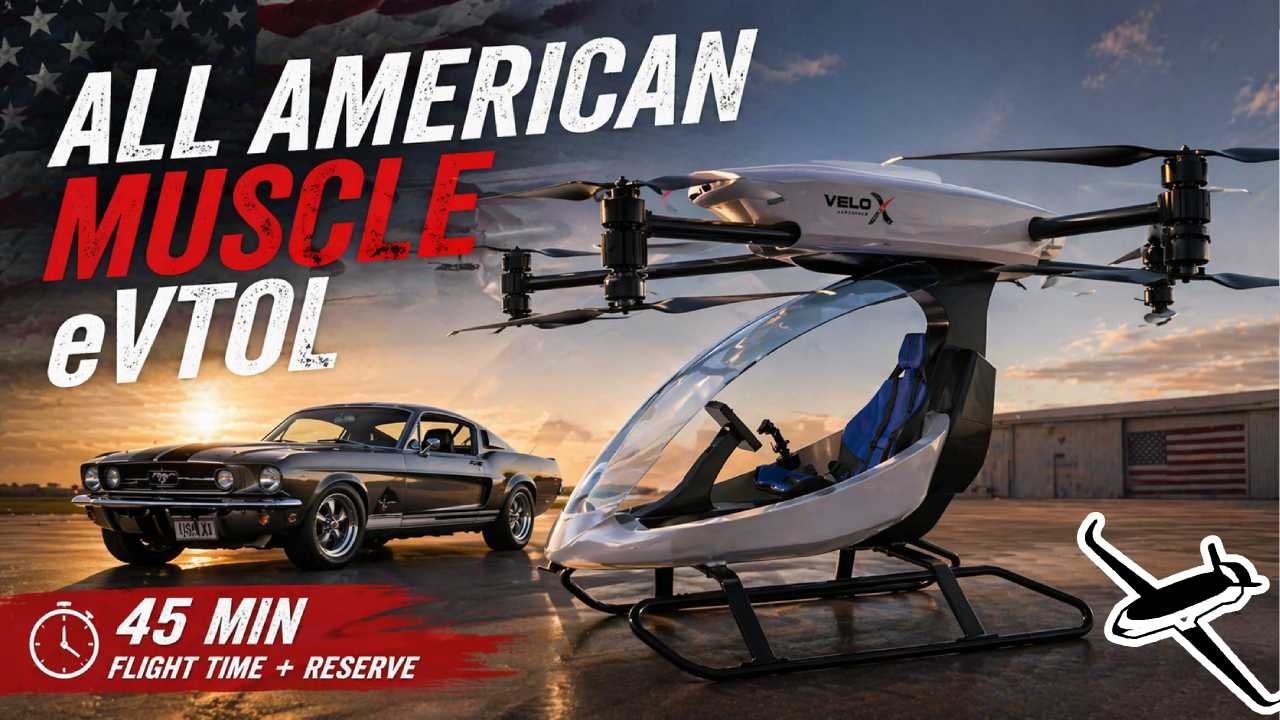
We’ve all seen the latest personal eVTOL videos—sleek machines that look incredible but often leave one big question unanswered: What can you actually do with just 10–15 minutes of flight time?
Now, a new contender has entered the space, and it’s aiming to change that narrative entirely. The Velocitor X1, developed by Velo X Aerospace, promises over 45 minutes of flight time with a 15-minute reserve. This isn’t just a machine for short hops or backyard flights—it’s designed to be a practical personal aircraft that can genuinely take you places.
The American Entry Arrives
The U.S. may be late to the personal eVTOL race, but the Velocitor X1 makes a bold entrance. Marketed as an “All-American Muscle” eVTOL, it emphasizes power, capability, and usability over minimalism.
One of its most notable features is its 118 kg (260 lbs) payload capacity, a significant improvement over many competitors that limit pilots to around 85 kg (187 lbs). For many prospective users, weight limits have been a major barrier—this alone could open the door to a much broader audience.
Add to that longer flight time and a standard ballistic parachute system, and the X1 begins to stand out as a more serious, safety-conscious platform.
Design Philosophy: Efficiency Over Agility
Unlike aircraft such as the Jetson ONE—which embrace a nimble, racing-drone-inspired design—the Velocitor X1 takes a different approach. It prioritizes efficiency and stability over extreme maneuverability.
This philosophy is most evident in its use of larger, high-efficiency propellers, which sacrifice agility in favor of longer, more efficient flight. The result is a platform better suited for cruising and utility missions rather than high-speed, low-altitude weaving.
The design also reflects a shift toward inclusivity. By scaling up the airframe, Velo X has addressed one of the most common concerns in the eVTOL community: pilot weight limitations.
A Practical and Safer Layout
The Velocitor X1 features a top-mounted rotor configuration, keeping the spinning blades well above the pilot and away from bystanders. This design choice enhances both perceived and actual safety.
Its layout shares some similarities with aircraft like the Zapata Airscooter but opts for a more rugged and simplified structure.
Battery placement is another thoughtful detail. The packs are positioned high, near the motors, which:
- Reduces cable length and electrical resistance
- Improves efficiency and weight distribution
- Keeps the center of gravity closer to the rotors, enhancing control responsiveness
In addition, the cockpit structure provides a degree of separation between the pilot and the batteries in the unlikely event of a thermal issue.
Real-World Utility
While widespread urban air mobility is still some distance away, the Velocitor X1 shines in rural and remote applications.
For large properties, ranches, or rugged terrain, the X1 could be a transformative tool. Tasks that might take hours on foot or by ATV could potentially be completed in minutes from the air.
Imagine surveying a thousand-acre property in under 10 minutes—this is where the aircraft’s extended range and endurance become genuinely valuable.
Technology and Flight Experience
The Velocitor X1 incorporates modern flight technology expected in this category:
- Eight electric motors in a coaxial configuration
- Full composite airframe
- Auto takeoff and landing
- GPS-locked hover capability
- Intuitive cockpit with joystick and collective controls
The dashboard integrates a dedicated Garmin GPS unit alongside the primary flight display, reinforcing its focus on real navigation rather than just recreational flying.
The Secret Sauce: Disc Area Efficiency
What truly sets the Velocitor X1 apart is its 57-inch propellers.
Compared to the 40-inch propellers used by aircraft like the Jetson ONE, this represents a 42.5% increase in diameter. However, in aerodynamics, performance gains come from disc area, which scales with the square of the diameter.
This means the Velocitor X1 has more than double the effective disc area, allowing it to:
- Move more air at lower speeds
- Generate lift more efficiently
- Significantly improve endurance
This design choice is a key reason behind its extended flight time.
Weight and Licensing Considerations
All of this capability comes at a cost—weight.
With an empty weight of approximately 227 kg (500 lbs), the Velocitor X1 exceeds the FAA’s Part 103 ultralight limit of 115 kg (254 lbs). As a result, it falls into the Light Sport Aircraft (LSA) category.
This means operators will need a sport pilot certificate to fly it, making it less accessible than ultralight alternatives—but also more capable and versatile.
Price and Development Status
The Velocitor X1 is currently in the late stages of development, with an asking price of around $156,000 USD.
Notably, this price includes Light Sport training, which adds value for first-time pilots entering this category.
While there has been a tethered test flight, there are not yet publicly available videos of a fully piloted free flight. However, the underlying quadcopter-style architecture has been proven across many other platforms.
Safety is further enhanced by the inclusion of a ballistic parachute system, providing an additional layer of redundancy in case of total system failure.
Final Thoughts
The Velocitor X1 represents a shift in the personal eVTOL space—from short-duration novelty flights toward practical, mission-capable aircraft.
With its extended flight time, higher payload capacity, and efficiency-focused design, it offers a compelling alternative to lighter, more restrictive competitors.
The trade-offs are clear: more weight, higher cost, and the need for a pilot license. But for those seeking real capability rather than just a flying experience, the Velocitor X1 may be one of the most promising options yet.