
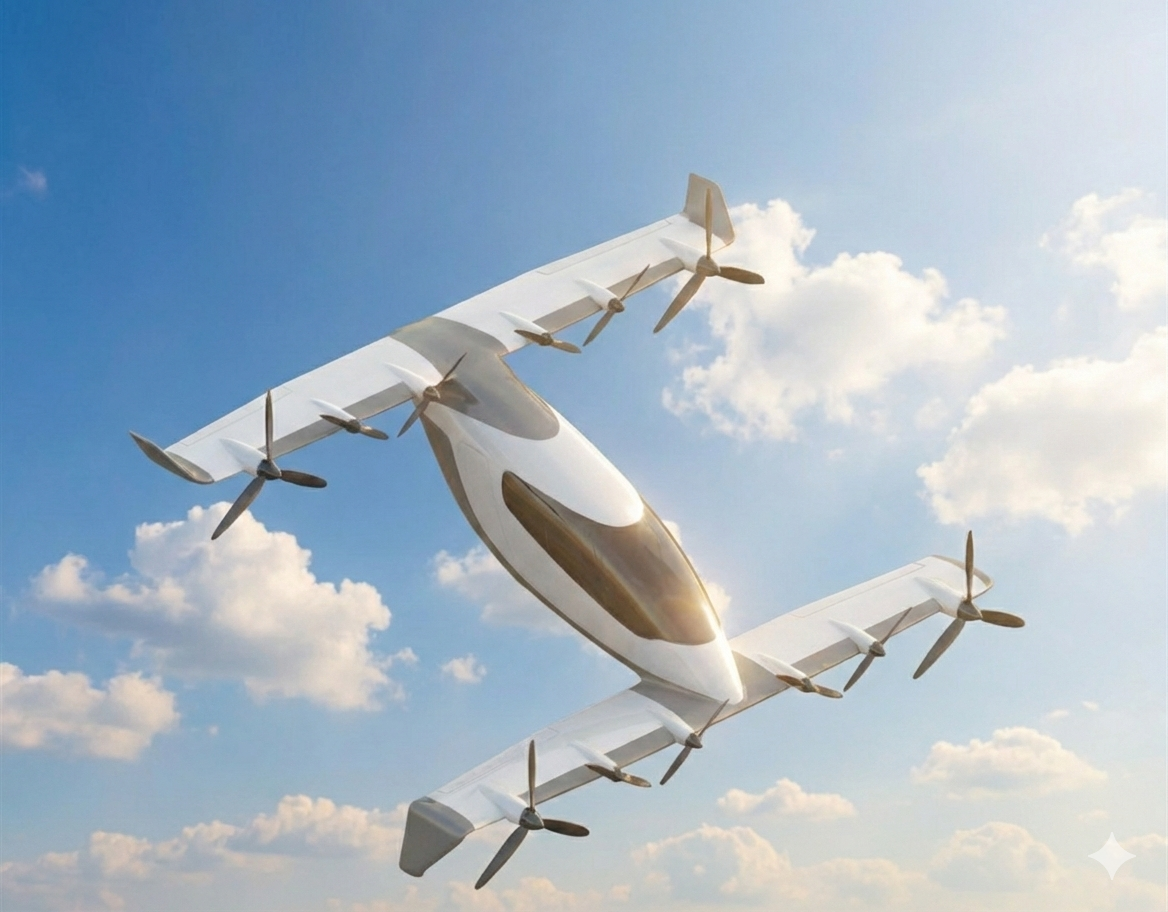
Did you ever wish the Pivotal Helix could stay in the air longer than 20 minutes? You’re not alone—and it turns out Pivotal has been thinking the same thing. The company has now revealed larger, more capable versions of the Helix, designed to push beyond the short-hop limitations of the original ultralight and into serious utility missions. Here’s what we know so far about the expanding Helix family, and why these new aircraft could matter far beyond recreational flying.
The Original Helix: A Backyard Aircraft With Real Potential
The Pivotal Helix is one of the coolest aircraft most people could realistically fly. It doesn’t require a pilot’s license, it has a compact footprint, and it delivers one of the smoothest transitions from vertical to horizontal flight in the eVTOL space. The trade-off is endurance: about 20 to 30 minutes, depending on pilot weight and ambient conditions. Price is another barrier, with the base version landing around $190,000.
Still, the Helix represents a rare thing in aviation: a genuinely approachable aircraft. It’s small enough to operate from a backyard and can be disassembled and stored in a modest garage. It also has a low noise signature, automated flight controls, and minimal rotor downwash—traits that make it unusually practical compared to other VTOL concepts. Even with limited range, the list of potential use cases is surprisingly broad.
Why the Helix Isn’t Just a “Toy”
It’s easy to see the Helix as purely recreational, but its features hint at much bigger possibilities. Imagine a “summon” function during emergency evacuations. Imagine paramedics reaching casualties within the golden hour. Those scenarios aren’t just thought experiments—Pivotal has already been exploring emergency response applications, and the company is actively developing larger Helix variants aimed at carrying more payload, flying farther, and serving real operational roles.
The key here is scalability. Much like the Rutan Long-EZ introduced a design philosophy that reshaped parts of fixed-wing aviation, the Helix’s tandem-wing tilt-body configuration is proving to be a flexible platform that can grow into multiple categories—from ultralight personal aircraft to serious cargo and defense systems.
Helix Deliveries Began in July 2025—And Expansion Plans Followed
Deliveries of the Pivotal Helix began in July 2025. Since then, the company’s leadership has confirmed plans for hybrid-electric variants aimed at expanding operational utility. The mission set being discussed is wide-ranging: special forces insertion and extraction, emergency medical response, firefighting, and cargo delivery.
That last point is important: Pivotal isn’t positioning Helix as a single aircraft, but as a family of aircraft. And with the new Class 2 and Class 3 designs, the Helix concept steps outside ultralight constraints.
A Quick Note on Regulations: Why Class 2 and Class 3 Are a Big Deal
The larger variants—Class 2 and Class 3—are not limited by Part 108 ultralight regulations. That regulatory freedom enables substantially higher payload and longer range. It also opens doors for missions that simply aren’t feasible with a 20–30 minute platform.
Even so, the original Helix remains relevant—especially for emergency services—because it doesn’t require a pilot’s license. The aircraft has already performed demonstration flights for emergency response in California, showing how it can cut response times dramatically while avoiding traffic congestion, long rural travel distances, and hostile terrain. Its low rotor downwash is especially attractive for firefighting operations compared to helicopters.
What Changed From BlackFly to Helix?
Compared to its predecessor—the third-generation BlackFly—the Helix includes roughly 97% new components. One notable upgrade is the use of cylindrical battery cells in a 9-kWh battery pack, which contributes to higher payload capability—up to 100 kg. In practical terms, an 80 kg pilot could still carry around 20 kg of medical gear or firefighting equipment, depending on conditions.
Now, let’s get into the two new variants.
Class 2 Helix: The Two-Seat, Practical Endurance Upgrade
The Class 2 Helix is a major step up in both size and capability.
Size and Layout
- Footprint: ~23 ft × 23 ft
- Original Helix footprint: ~14.5 ft × 14.5 ft
Instead of four rotors on each tandem wing, Class 2 uses six, with the outermost rotor being three-bladed. It also swaps the forward wingtip fence for a blended wingtip design, suggesting aerodynamic refinements aimed at efficiency and stability.
Performance and Capability (Estimated)
- Endurance: ~2 hours 40 minutes (battery or hybrid)
- Payload: ~600 lb (272 kg)
- Range: ~200 miles
- Cruise speed: ~105 knots
- Operations: optionally piloted or highly automated
While it’s primarily being developed with defense applications in mind, it also happens to hit a sweet spot many personal aviation enthusiasts have been waiting for: a truly practical two-seat recreational option with endurance measured in hours, not minutes.
Class 3 Gen 6: The Heavy-Lift “Big Brother” Helix
If Class 2 is the practical leap, Class 3 is the full transformation into a utility platform.
Size and Airframe
- Footprint: ~35 ft × 35 ft
- Landing gear: skids
- Propulsion: four large four-bladed propellers
Higher blade counts are becoming increasingly common in larger eVTOL aircraft—seen in designs from companies like Vertical Aerospace and Archer—because thrust efficiency becomes far more critical once you move beyond ultralight weight limits.
Performance and Capability (Estimated)
- Range: up to ~300 nautical miles
- Top speed: ~130 knots
- Endurance: approaching ~3 hours 45 minutes
- Payload: ~3,000 lb (1,360 kg)
- Primary role: cargo operations, including sling-load missions
One standout differentiator is its V-tail with ruddervators, which the other variants don’t have. That adds control authority—especially useful as airframes scale up and mission complexity increases.
The Core Idea: A Scalable Tilt-Body Platform
Across all three aircraft, the most interesting story may be the design philosophy itself. The tandem-wing tilt-body configuration at the heart of Pivotal’s approach isn’t just novel—it’s proving adaptable across wildly different mission profiles. The original Helix can operate from small spaces with low downwash and simplified controls. Class 2 brings multi-hour endurance and meaningful payload. Class 3 turns the concept into a heavy-lift cargo workhorse.
That’s a rare arc in aviation: one platform concept scaling cleanly from leisure flying to emergency response and logistics.
Why Class 2 Might Be the Sweet Spot
For many people, the dream isn’t a flying cargo crane—it’s a two-seat aircraft you could actually use for real trips and real experiences. That’s why Class 2 stands out. With more than two hours of endurance and enough payload to support practical operations, it feels like the first Helix variant that could bridge the gap between “cool tech demo” and “viable recreational aircraft.”
Final Thought
Pivotal’s Helix started as a compact ultralight with limited endurance—but the larger Class 2 and Class 3 variants suggest a much bigger ambition: turning Helix into a family of aircraft that can serve recreation, emergency response, defense, and cargo at multiple scales.
Which Pivotal aircraft excites you the most—the original Helix, Class 2, or Class 3?
Dear Haroon Junaidi,
Please refrain from disiminating the NO PILOT LICENSE REQUIRED lie.
You are wrong and people get themselves in enormeous trouble following such deceptive advise.
You are not an FAA inspector not even a flight instructor and have no idea what you are talking about.
Kind regards,