
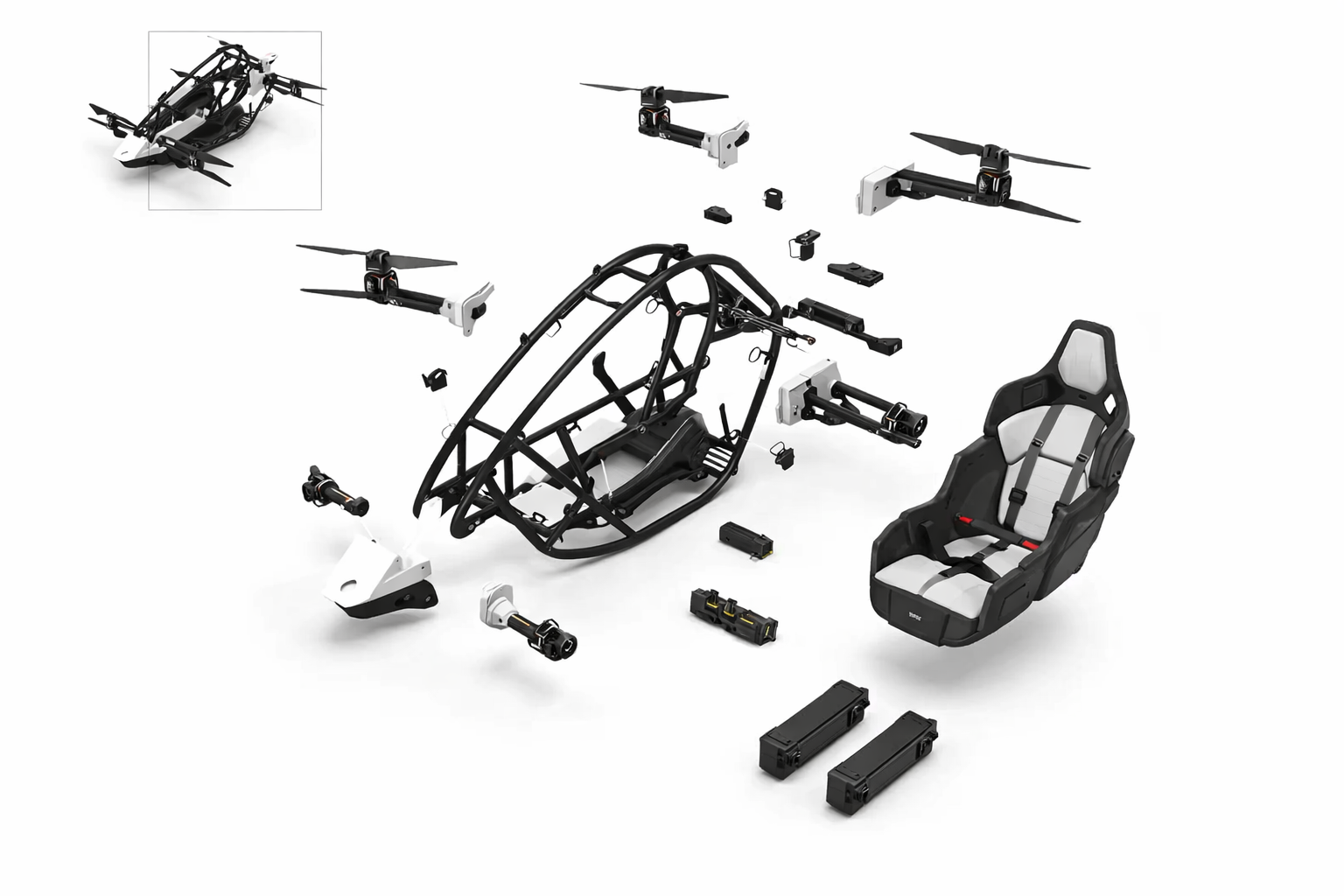
Everyone on the internet seems to think they can build a Jetson One–style aircraft for the price of a used Honda Civic.
“It’s just a big drone,” they say.
“Five thousand dollars, tops.”
Let’s call that bluff.
When you break down the components of a personal eVTOL (electric vertical takeoff and landing aircraft) like the Jetson One, the reality becomes very different. What looks simple on the outside hides a surprising amount of engineering complexity—and cost.
The Illusion of Simplicity
At first glance, a Jetson-style aircraft doesn’t seem overly complicated. It’s essentially:
- A lightweight frame
- Multiple motors with propellers
- A seat and joystick
- A battery
- A flight computer
And thanks to the rapid growth of the drone industry, many of these components are now available off the shelf.
But here’s the catch: there’s a massive difference between hobby-grade parts and human-carrying aviation hardware.
The Core Components (and Their Real Costs)
Let’s walk through the major systems one by one.
1. Airframe
The Jetson One popularized a roll-cage style frame—lightweight, strong, and offering some pilot protection.
- Material options:
- 6061-T6 aluminum tubing (welded)
- Carbon-fiber composites (bonded)
- Estimated raw material cost:
- ~$700
That might sound cheap—but this excludes fabrication, welding, and structural validation, which are far from trivial.
2. Motors and Propellers
This is where things escalate quickly.
Small drone motors (~$50) are irrelevant here. To lift a human, you need industrial heavy-lift propulsion systems.
- Motor cost:
- $1,000–$5,000 each
- 8 motors required → ~$8,700 (conservative estimate)
- Propellers (carbon fiber):
- $500–$1,500 each
- Total → ~$4,000
Running total: ~$12,700
Why So Expensive?
Because these components must:
- Generate massive thrust
- Stay lightweight
- Handle high thermal loads
- Operate reliably under extreme conditions
This is much closer to aerospace engineering than hobby electronics.
3. Thrust Requirements (Why You Need So Much Power)
Let’s assume:
- Total weight (aircraft + pilot): 200 kg
- Required thrust margin: +10–20%
So total thrust needed ≈ 220 kg
With a coaxial setup (8 rotors):
- Each arm must generate ~55 kg of thrust
This pushes you firmly into industrial-grade propulsion systems—not DIY drone parts.
4. Electronic Speed Controllers (ESCs)
Unlike airplanes, multicopters don’t use control surfaces. They maneuver by adjusting motor speeds.
That means ESCs are critical.
- Must handle:
- 200+ amps
- High precision control
- Heat management
- Cost:
- $200–$1,000 each
- Total → ~$1,600
Running total: ~$14,300
5. Battery System (The Biggest Constraint)
This is the single most demanding component.
- Average power draw: ~45 kW
- Battery weight: ~60 kg
- Capacity: 12–14 kWh
Cost estimate:
- ~$150/kWh (bulk) → doubles for one-off builds
- ~$3,600–$4,200
Running total: ~$17,900
The Hidden Challenge: Heat & Efficiency
High discharge rates reduce efficiency and increase heat (Peukert effect).
Push too hard, and your battery becomes both inefficient—and dangerous.
6. Controls and Flight Computer
- Aviation-grade joystick:
- ~$1,000
- Flight controller hardware:
- $100–$500
Running total: ~$19,000
But here’s the critical part:
The hardware is cheap. The software—and integration—is not.
The Real Cost: Engineering
At this point, you’ve spent nearly $20,000—and you still don’t have:
- Flight control software
- Stability tuning
- Fail-safe systems
- Redundancy
- Testing and validation
And this is where most DIY assumptions fall apart.
If a hobby drone crashes, you lose a camera.
If this crashes, you fall out of the sky.
Why the Jetson One Costs So Much
The Jetson One sells for around $128,000.
Is that justified?
That’s a separate debate—but a large portion of that price comes from:
- Engineering time
- Safety systems
- Testing and certification
- Reliability requirements
Not just raw parts.
Final Thoughts
Yes, you can build something that looks like a Jetson One for relatively cheap.
But building something that is:
- Safe
- Reliable
- Controllable
- Repeatable
…is an entirely different challenge.
That’s the hidden cost most people underestimate.
Cost Breakdown Summary
| Component | Estimated Cost (USD) |
|---|---|
| Airframe (raw materials) | $700 |
| Motors (8 units) | $8,700 |
| Propellers | $4,000 |
| ESCs | $1,600 |
| Battery Pack | $3,600 – $4,200 |
| Joystick | $1,000 |
| Flight Controller | $100 – $500 |
| Total (approx.) | ~$19,000+ |
Bottom line:
It’s not “just a big drone.”