
The race to commercialise electric vertical take-off and landing (eVTOL) aircraft is heating up. Companies such as Joby Aviation, Archer Aviation, Beta Technologies and Vertical Aerospace have dominated the headlines, attracting significant investment and building international partnerships.
However, beyond these familiar names, a quieter revolution is taking place. Several lesser-known aircraft manufacturers have made remarkable progress, with some already conducting advanced flight testing and progressing through certification programmes.
Interestingly, many of these emerging competitors are based in China, where the rapidly expanding low-altitude economy has attracted both aviation startups and established automotive manufacturers.
Some of these aircraft also bear a striking resemblance to their Western counterparts, while others have adopted quite different engineering approaches.
Here are five lesser-known air taxis that could become serious contenders in the emerging advanced air mobility market.
1. GOVY AirJet – The Air Taxi with Ducted Fans
The first aircraft is the GOVY AirJet, a four-seat electric air taxi developed by GOVY, the low-altitude mobility division of Chinese automotive giant GAC Group.
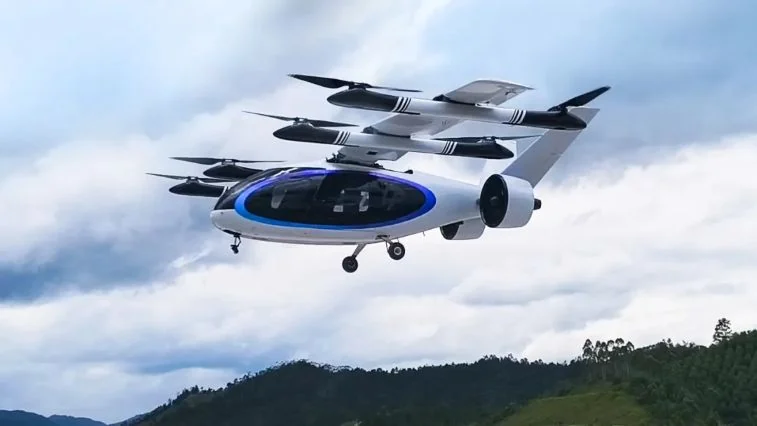
The AirJet adopts a lift-plus-cruise configuration, combining eight dedicated lift propellers with two ducted fans for forward propulsion.
The use of ducted fans is particularly interesting, as relatively few air taxis have adopted this approach. Earlier designs from Embraer-backed Eve Air Mobility also incorporated ducted propulsion, although the company subsequently moved to a conventional pusher propeller arrangement.
Ducted fans offer several potential advantages, including improved safety through enclosed blades and the possibility of reducing certain components of propeller noise. However, they also introduce additional structural weight and aerodynamic challenges.
The AirJet is designed for autonomous flight, eliminating the need for a conventional pilot-operated cockpit. Its advertised specifications include a range of 200 kilometres (124 miles) and a flight speed of approximately 250 km/h (155 mph).
One of GOVY’s biggest advantages is its automotive heritage.
Its parent company, GAC Group, is among China’s largest automobile manufacturers and operates joint ventures with global manufacturers including Toyota and Honda. In July 2026, GAC celebrated the production of its 30 millionth vehicle.
This automotive backing could prove valuable when the company begins scaling aircraft production, particularly in areas such as electric propulsion, batteries, electronics and manufacturing.
GOVY has also been developing a smaller aircraft called the AirCab.
Unlike the AirJet, the AirCab is a two-seat autonomous multicopter intended primarily for shorter journeys. In May 2026, GOVY rolled out its first AirCab from a newly established manufacturing facility in Guangzhou.
The facility has a planned annual production capacity of 100 aircraft. Commercial deliveries were initially targeted for late 2026, subject to obtaining the necessary aviation certifications.
The AirJet itself is intended for longer intercity journeys, with commercial operations targeted later in the decade.
With GAC’s manufacturing experience and financial resources behind it, GOVY is certainly a company worth watching.
2. TCab Tech E20 – A Unique Combination of Tilt-Rotor and Tilt-Wing Technology
The second aircraft is the TCab Tech E20, another relatively overlooked Chinese air taxi with an interesting propulsion architecture.
The E20 combines elements of a conventional tilt-rotor aircraft with lift-plus-cruise technology.
It has six propulsion positions, four of which incorporate tilting rotors, while the remaining two are dedicated to vertical lift.
However, what makes the E20 especially interesting is the arrangement of the outer tilt-rotors on its main wing.
Unlike a conventional tilt-rotor aircraft, where only the propeller nacelle rotates, the E20 also tilts the outboard sections of its wings along with the rotors.
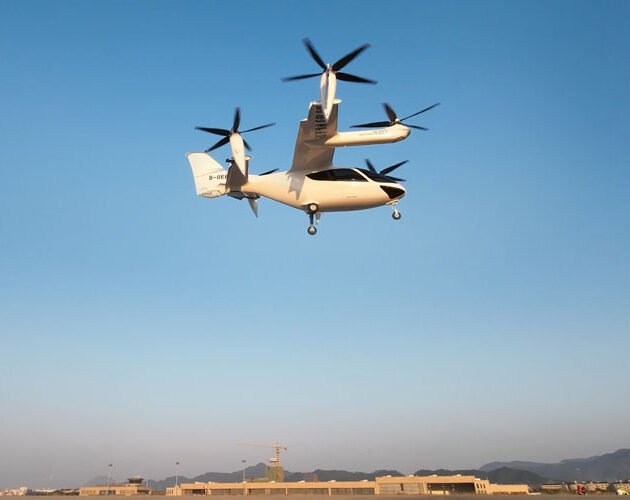
Tcab Tech E20
This effectively creates a partial tilt-wing configuration.
The arrangement offers some of the aerodynamic advantages associated with tilt-wing aircraft, without requiring the entire main wing to rotate.
For example, rotating the outboard wing sections can help reduce the undesirable interaction between the rotor downwash and the wing during vertical flight. The configuration may also improve airflow management and lift generation during the transition between hovering and forward flight.
These characteristics are particularly important because the transition phase is one of the most demanding aspects of eVTOL flight.
The E20 accommodates four passengers and one pilot. It has a manufacturer-claimed range of 200 kilometres (125 miles), a cruising speed of approximately 260 km/h (162 mph) and a maximum speed of 320 km/h (199 mph).
Another noteworthy aspect of the aircraft is its electrical architecture.
The E20 uses an 800-volt electrical system with four independent battery packs.
Operating at a higher voltage allows the aircraft to transmit the same electrical power at a lower current. This can reduce resistive losses and potentially decrease conductor weight, an important consideration in weight-sensitive electric aircraft.
TCab has already progressed considerably beyond its initial prototype development.
The company has completed transition-flight testing, including crewed flight demonstrations, and is progressing through the certification process with the Civil Aviation Administration of China (CAAC).
It has also been developing a manufacturing facility covering approximately 10 acres, with a planned annual production capacity of 200 aircraft.
TCab is targeting type certification in 2027, followed by commercial entry into service in 2028.
If the company achieves these targets, the E20 could become one of the earlier piloted eVTOL aircraft to enter commercial service.
3. Aerofugia AE200 – Geely’s Six-Seat Air Taxi
The next aircraft has perhaps the most unusual tail arrangement of the five aircraft covered here.
It is the Aerofugia AE200, developed by another Chinese company with substantial automotive backing.
The AE200 features a distinctive X-shaped empennage, with two tilting rotors mounted on the upper V-shaped section of its tail.
In addition, the aircraft incorporates two tilting rotors on its main wing and four dedicated lift rotors.
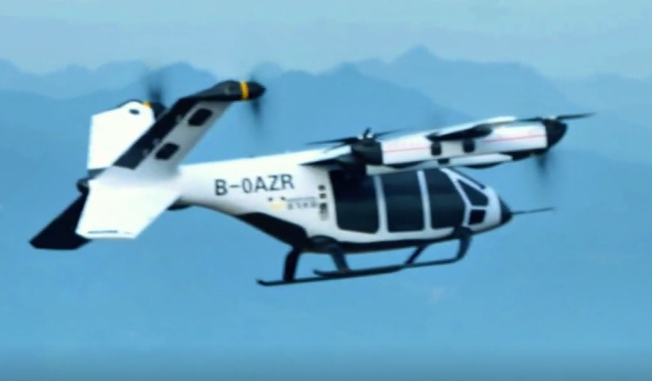
Aerofugia AE200
Altogether, the AE200 uses eight rotors, four of which tilt to provide forward propulsion during cruise.
This configuration allows the aircraft to transition from vertical take-off to conventional wing-borne flight, where the wings provide most of the lift.
The company behind the AE200, Aerofugia, was established in September 2020 and is part of the Geely automotive group.
Geely is one of China’s most prominent automotive manufacturers, with interests in international brands including Volvo Cars, Polestar and Zeekr.
Consequently, Aerofugia benefits from access to an extensive automotive engineering and manufacturing ecosystem.
The AE200 is designed to accommodate between three and six occupants, depending on its seating configuration.
Its advertised performance includes a range of 200 kilometres (124 miles) and a cruising speed of approximately 230 km/h (143 mph).
However, what makes the AE200 particularly noteworthy is the progress it has achieved in development.
The production configuration of the AE200-100 was unveiled in November 2024, followed by the rollout of its first production-intent aircraft in September 2025.
By December 2025, Aerofugia reported completing the first phase of verification flights.
These developments place the AE200 well beyond the conceptual stage, with the aircraft actively progressing through the Chinese airworthiness certification process.
Although obtaining type certification remains a significant challenge, Aerofugia could become one of the earliest manufacturers to introduce a certified piloted air taxi into commercial operation.
4. XPENG ARIDGE A868 – A Hybrid Air Taxi with a 500 km Range
Among the five manufacturers covered here, XPENG is perhaps the best known internationally.
The Chinese electric vehicle manufacturer has already attracted considerable attention with its ambitious flying-car projects.
One of these is the XPENG Land Aircraft Carrier, an unusual six-wheeled vehicle designed to transport and deploy a detachable two-seat eVTOL aircraft.
However, XPENG’s aviation division, ARIDGE, has now expanded its ambitions into the commercial air taxi market with the A868.
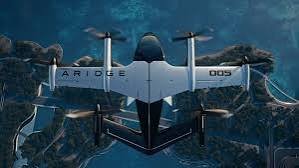
Unlike the Land Aircraft Carrier, the A868 is a full-sized, six-seat aircraft intended for longer-distance passenger transport.
The aircraft features a full tilt-rotor configuration with six propellers.
Four of these are mounted on the main wings, while the remaining two are positioned on its V-shaped tail.
The arrangement bears a striking resemblance to the Joby S4, although the A868 features a different fuselage design and has been developed around a six-occupant cabin.
However, the most significant difference between the two aircraft lies in their propulsion systems.
While Joby’s aircraft is designed around battery-electric propulsion, XPENG has adopted a hybrid-electric architecture for the A868.
The aircraft uses an onboard range-extending power source to supplement its electrical propulsion system.
This allows XPENG to target substantially greater range than most battery-electric air taxis.
According to the company, the A868 is being developed to achieve a range of approximately 500 kilometres (310 miles) and a maximum cruising speed of 360 km/h (224 mph).
These are ambitious performance figures.
For comparison, most battery-electric air taxis currently under development advertise ranges closer to 150–250 kilometres.
The hybrid system potentially allows the A868 to overcome one of the biggest limitations of electric aviation: the comparatively low energy density of present-day lithium-ion batteries.
However, this approach also introduces certain disadvantages.
An onboard range extender adds weight, mechanical complexity and additional maintenance requirements. Depending on its fuel and operating characteristics, it also introduces operational emissions that would not be present in a purely battery-electric aircraft.
Nevertheless, hybrid-electric propulsion could offer a practical pathway towards longer-range regional air mobility, particularly where battery-electric technology struggles to deliver sufficient range and payload simultaneously.
The A868 made its public debut in November 2025, when XPENG also confirmed that the aircraft had entered its flight-testing phase.
At present, the aircraft remains under development, and its impressive performance figures should be regarded as design targets rather than independently verified or certified capabilities.
Still, XPENG has extensive experience in electric vehicle technology and has spent years developing electric aircraft through its aviation division.
The A868 could therefore become a serious contender, particularly in the longer-range segment of the air taxi market.
5. Volant Aerotech VE25-100 – The Skylar Air Taxi Already Making Piloted Transition Flights
The fifth and final aircraft is the Volant Aerotech VE25-100, commercially known as the Skylar.
While its configuration is relatively conventional compared with some of the other aircraft covered here, its progress through flight testing makes it particularly interesting.
The VE25-100 is designed to accommodate six occupants, comprising one pilot and five passengers.
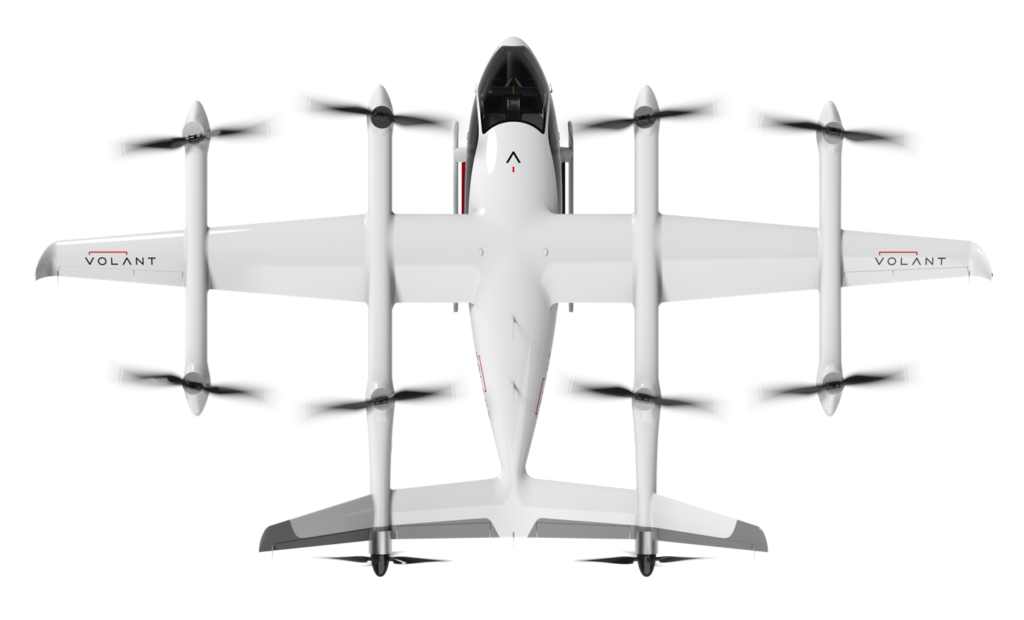
It is also a relatively large aircraft, with a wingspan of 16 metres and a maximum take-off weight of approximately 2,500 kilograms.
Its commercial payload capacity is listed at 500 kilograms, comparable to the payload targets of several competing air taxi programmes.
Volant advertises a cruising speed of approximately 235 km/h (146 mph) and a range of 200–400 kilometres (124–249 miles), depending on operating conditions and configuration.
Unlike the tilt-rotor arrangements used by XPENG and TCab, the VE25-100 adopts a lift-plus-cruise configuration.
The aircraft uses eight dedicated lift propellers for vertical take-off and landing, together with two rear-mounted pusher propellers for forward propulsion.
In this respect, its propulsion philosophy is closer to aircraft such as the Beta ALIA and Eve’s air taxi than to the Joby S4.
However, where the VE25-100 becomes particularly interesting is its development progress.
In October 2025, Volant successfully completed piloted flight testing with its VE25-100 development aircraft.
Then, in May 2026, the company achieved an even more significant milestone: a piloted transition flight.
During this demonstration, the aircraft transitioned from rotor-supported vertical flight into wing-borne forward flight.
This represents a critical achievement for an eVTOL aircraft because the transition requires precise coordination of propulsion, aerodynamics and flight-control systems.
Volant followed this achievement with the rollout of its first airworthiness-configuration aircraft, designated AC102, in August 2026.
The company has also begun securing commercial commitments.
In October 2026, Volant announced an agreement with Sichuan Airlines Group’s low-altitude aviation business covering 50 VE25-100 aircraft.
Of these, 20 were firm orders, while the remaining 30 were covered by letters of intent.
Although the aircraft has yet to receive type certification, these developments demonstrate that the programme has progressed considerably beyond computer renderings and preliminary flight demonstrations.
Volant is now targeting type certification in 2027.
With advanced piloted flight testing already completed and commercial customers beginning to emerge, the VE25-100 is potentially one of the strongest contenders among China’s developing passenger eVTOL aircraft.
Could China’s Air Taxis Challenge the Established Western Manufacturers?
The five aircraft covered here demonstrate how quickly China’s passenger eVTOL industry is developing.
What is particularly interesting is the diversity of engineering approaches.
GOVY has opted for ducted fans combined with dedicated lift propellers. TCab has developed an unusual configuration combining tilt-rotor and partial tilt-wing technology. Aerofugia has adopted an eight-rotor arrangement with a distinctive X-shaped tail. XPENG is pursuing a hybrid-electric tilt-rotor capable of substantially longer journeys, while Volant has concentrated on a relatively conventional lift-plus-cruise architecture.
There is another important similarity between several of these manufacturers.
Three of them — GOVY, Aerofugia and XPENG ARIDGE — have the backing of major automotive companies.
This provides access to manufacturing expertise, automotive-grade electrical technologies, established supply chains and potentially significant financial resources.
These are advantages that many independent aviation startups struggle to obtain.
However, manufacturing an electric aircraft is only part of the challenge.
Certification, operational safety, battery performance, reliability, vertiport infrastructure and commercial viability will ultimately determine which companies succeed.
It is also important to distinguish between aircraft that have successfully completed flight testing and those that have received the regulatory approvals necessary for commercial passenger operations.
As of October 2026, none of these five passenger aircraft has obtained its full type certificate.
Nevertheless, the progress achieved by companies such as TCab, Aerofugia and Volant suggests that several Chinese manufacturers are now serious contenders in the global advanced air mobility industry.
The question is no longer simply whether Joby, Archer, Beta or Vertical Aerospace will succeed.
It is whether some of their lesser-known competitors could reach the commercial market first — and potentially challenge them on cost, manufacturing scale and operational capability.
Which of these five air taxis has the greatest potential? And could China’s emerging eVTOL manufacturers become serious competitors to their Western counterparts?