
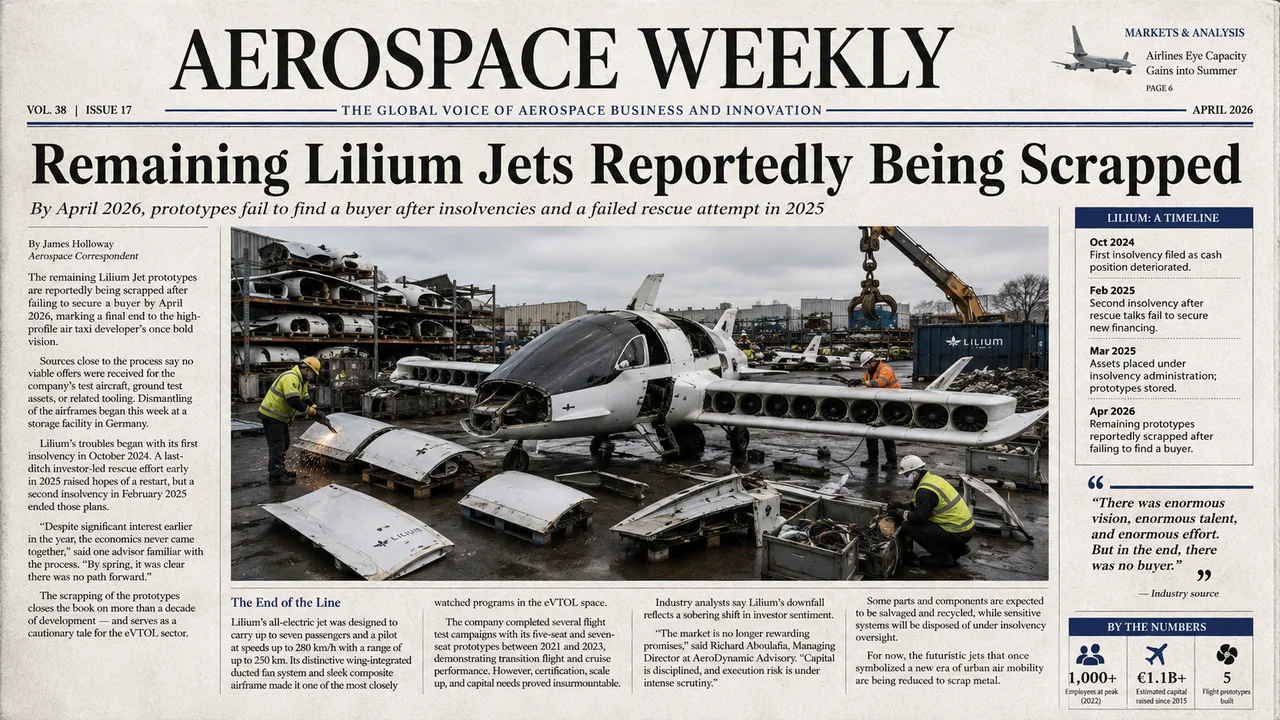
When the Lilium Jet first appeared publicly in 2015, it seemed to represent the beginning of a new era in aviation.
The aircraft looked unlike almost anything that had come before it. Its smooth, almost manta-ray-shaped fuselage had no conventional tail, while much of its flight control was integrated directly into its propulsion system. Lilium’s technical assessments suggested a lift-to-drag ratio of around 18.4 — approaching that of an efficient conventional aircraft.
But its most distinctive feature was its propulsion system.
Instead of using a handful of large propellers, the Lilium Jet relied on dozens of small electric ducted fans integrated into its wings and canards. These propulsion units could rotate to provide vertical lift during take-off and landing before transitioning to forward thrust in cruise.
Lilium called the system Ducted Electric Vectored Thrust, or DEVT.
The concept helped make Lilium one of the frontrunners of the emerging electric aviation industry. The company attracted major investment, developed increasingly sophisticated prototypes and pursued one of the most ambitious aircraft programmes in the eVTOL sector.
Yet the story ended very differently.
In October 2024, Lilium’s two principal German subsidiaries entered insolvency proceedings. A subsequent attempt to rescue the company failed, resulting in another insolvency filing in February 2025. By April 2026, the remaining Lilium Jet prototypes had reportedly failed to find a buyer and were being dismantled.
So what went wrong?
The answer may lie partly in the very technology that made the Lilium Jet so distinctive.
The Crown Jewel: Lilium’s Electric Ducted Fans
Electric ducted fans, or EDFs, are not a new invention. They became particularly popular among radio-controlled aircraft enthusiasts during the 2000s as lightweight lithium-polymer batteries and increasingly powerful brushless electric motors became widely available.
A properly designed ducted fan can offer some important advantages.
Compared with an open propeller of the same diameter, a duct can reduce blade-tip losses and can itself contribute additional pressure thrust. Stator vanes behind the rotor can remove swirl from the exhaust and recover some of the energy that would otherwise be lost in the rotating wake.
Ducts also provide opportunities for acoustic treatment and can offer greater physical protection around the rotating blades.
Tests of ducted propellers have demonstrated substantially greater static thrust than similarly sized isolated propellers under some operating conditions.
For Lilium, however, ducted fans were not simply an alternative to conventional propellers. They formed the basis of the entire aircraft architecture.
36 Fans Supporting a 3.2-Tonne Aircraft
Lilium’s 2021 seven-seat reference configuration used 36 ducted fans.
Each had a shroud diameter of approximately 29.5 cm and a duct length of around 70 cm. The aircraft’s maximum take-off mass was listed at approximately 3,175 kg.
Lilium subsequently redesigned the production aircraft around 30 propulsion units, but the earlier 36-fan architecture remains useful because more detailed technical information is publicly available for it.
At maximum take-off mass, the aircraft would weigh approximately 31,100 newtons.
Dividing this load between 36 fans means that each fan would need to produce around:
865 N of thrust
That is equivalent to roughly 88 kg of thrust per fan, simply to hold the aircraft in a stationary hover.
And that is before allowing additional thrust for climbing, manoeuvring or maintaining control margins.
The fans could theoretically generate the required thrust. The more difficult question was how much power was needed to do it.
Lilium’s Disc-Loading Problem
One of the most important parameters for understanding vertical-flight efficiency is disc loading.
Disc loading is essentially the aircraft’s weight divided by the total area through which its rotors accelerate air.
Using the full 29.5 cm diameter of all 36 fans gives the Lilium Jet a combined rotor area of approximately:
2.46 m²
For an aircraft weighing 3,175 kg, that produces a mass-based disc loading of approximately:
1,290 kg/m²
That is extremely high compared with many competing eVTOL designs.
Published estimates for the Joby S4, for example, generally place its disc loading somewhere around 46–60 kg/m², depending on the assumed aircraft weight and rotor dimensions.
The fundamental physics behind this difference is important.
A large rotor moves a large volume of air relatively slowly. A small rotor must accelerate a much smaller quantity of air to a considerably higher velocity to produce the same amount of thrust.
Accelerating air to higher velocities requires more power.
This is why helicopters typically use very large rotors and why multirotor eVTOL aircraft usually try to maximise their available rotor area.
Lilium effectively attempted to support an aircraft weighing more than three tonnes using only a few square metres of total fan area.
How Much Power Did Lilium Need to Hover?
Using the published 36-fan geometry and a maximum aircraft mass of 3,175 kg, a simplified momentum-theory calculation gives an idealised hover-power requirement in the region of:
1.2 MW
This calculation assumes a very favourable thrust benefit from the ducted fans.
Real-world losses involving motors, inverters, ducts, rotors, flow interactions and other components would further influence the actual power requirement.
For comparison, one published performance analysis estimated approximately 500 kW for the Joby S4 during a vertical climb at around 5 m/s.
The numbers are not directly interchangeable because aircraft mass, rotor efficiency, climb rate and operating conditions differ.
Nevertheless, the comparison highlights the fundamental challenge facing Lilium.
Its relatively small total rotor area meant that vertical flight could demand dramatically more power than aircraft using large, slowly rotating propellers.
The Battery Problem
This high power requirement created another challenge.
Batteries must provide both energy and power, but optimising for both at the same time is difficult.
Energy density determines how much total energy can be carried for a given battery mass and therefore strongly influences aircraft range.
Power density determines how quickly that energy can be delivered.
Lilium required a battery capable of providing high energy density for cruise while also delivering enormous bursts of power during vertical take-off and landing.
High electrical current creates heat, with resistive losses increasing approximately with the square of current.
The consequences extend beyond the battery cells themselves.
The aircraft’s:
- busbars
- cables
- contactors
- switches
- inverters
- electric motors
- cooling systems
all have to be designed around the maximum power requirement.
Lilium also had to ensure that sufficient power remained available during the final vertical landing, when the battery would already be at a lower state of charge.
Could Silicon-Anode Batteries Solve the Problem?
Lilium believed advanced battery technology would help overcome these limitations.
The company invested in and partnered with battery developer Ionblox, which has worked extensively with silicon-dominant anodes.
Ionblox published cell-level power-density figures of approximately 3.8 kW/kg at 50% state of charge and around 3 kW/kg at 30% state of charge.
Silicon is extremely attractive as an anode material because it can theoretically store considerably more lithium than conventional graphite.
But it creates major engineering challenges.
Silicon expands significantly during charging and contracts during discharge. Repeated cycling can lead to swelling, cracking of active material and degradation of the solid-electrolyte interface.
Developing silicon-anode technology is therefore not simply about achieving impressive laboratory performance. For aviation, cells must also demonstrate reliability, longevity, manufacturability and ultimately certifiability.
That is a much higher barrier.
Lilium’s Great Strength: Efficient Cruise
Interestingly, Lilium’s concept potentially became much more attractive once the aircraft had completed its vertical take-off and transitioned into forward flight.
Earlier company material suggested a cruise-power requirement of less than 200 hp, equivalent to roughly 150 kW.
Once the aircraft was wing-borne, the fans no longer needed to support its full weight through direct vertical thrust.
The wings, canards and fuselage generated aerodynamic lift, leaving the propulsion system primarily responsible for overcoming drag.
This was one of the strongest aspects of the Lilium concept.
The aircraft may have required more than 1 MW during hover but only around 150 kW in efficient cruise.
Unfortunately, this also exposed one of the central engineering problems.
The electrical system still had to be sized for that enormous peak power requirement.
Even if the aircraft used maximum power for only a small portion of every flight, the batteries, conductors, motors, inverters and cooling hardware still had to survive those loads.
That equipment then had to be carried for the entire flight.
Was Vertical Take-Off Lilium’s Biggest Strategic Mistake?
This raises an interesting question.
Did the Lilium Jet actually need to be an eVTOL?
Without the requirement for stationary vertical flight, much of the extreme power requirement disappears.
Consider a simplified conventional take-off scenario.
Assume:
- aircraft mass: 3,175 kg
- lift-to-drag ratio: 15
- flight speed: 50 m/s
The useful aerodynamic power needed merely to overcome drag would be approximately:
104 kW
Adding a climb rate of 3 m/s requires roughly another:
93 kW
After accounting for propulsion and electrical losses, the initial wing-borne climb might therefore require approximately:
240–270 kW
The ground-acceleration phase could briefly require more power depending on runway length and acceleration requirements.
But even then, it remains dramatically below the power needed to hover.
Compared with an estimated 1.2 MW hover requirement, conventional wing-borne take-off could potentially reduce peak propulsion power by roughly 77%.
That is an enormous difference.
Of course, such an aircraft would require a runway.
And that removes one of the major selling points of an eVTOL aircraft.
But it also removes the most energy-intensive and technically demanding portion of the mission.
Lilium might therefore have had a very interesting aircraft even without true VTOL capability: a highly efficient electric regional aircraft using distributed ducted propulsion and capable of operating from relatively short runways.
Was Seven Seats Too Ambitious?
Lilium’s second major strategic challenge was scale.
The company was not attempting to build a lightweight one- or two-seat aircraft. Its reference configuration eventually grew into a seven-seat machine weighing more than three tonnes.
For a fixed rotor area, ideal induced power increases approximately according to:
P ∝ T³ᐟ²
In other words, power requirements rise faster than aircraft weight.
As aircraft mass increases without a corresponding increase in rotor area, vertical flight becomes disproportionately more difficult.
Lilium was therefore attempting to combine two challenging design choices:
a relatively large aircraft and an extremely small total rotor area.
Doing either individually is difficult.
Doing both simultaneously placed enormous demands on the propulsion and battery systems.
The High-Velocity Exhaust Problem
Small fans introduce another issue: high exhaust velocity.
Because each rotor has limited area, the air must be accelerated much more aggressively to produce sufficient thrust.
This tends to produce higher-frequency aerodynamic noise.
Lilium argued that enclosing the rotors gave it greater control over noise than an open-propeller configuration.
There is some logic behind this.
Ducts can provide acoustic shielding and may incorporate sound-absorbing materials.
However, the final noise characteristics of the production Lilium Jet were never demonstrated in full-scale commercial operation.
Whisper Aero Shows Another Way
The underlying idea behind Lilium’s propulsion system has not disappeared.
Whisper Aero provides an interesting example.
Its JetFoil concept also places arrays of electrically driven fans into aerodynamic surfaces.
However, rather than relying exclusively on direct fan thrust to support a large aircraft in a stationary hover, the system can use high-speed airflow to energise the wing.
Whisper’s CLA Light concept was initially presented as a conventional or short-take-off aircraft using powered-lift effects.
In 2026, the company also revealed near-VTOL JetFoil concepts designed to achieve extremely short or nearly vertical take-offs by blowing air over aerodynamic surfaces to generate substantial lift.
The distinction is important.
Instead of asking the propulsion system to produce virtually all the aircraft’s lift directly, the high-speed airflow is used to make the wing itself much more effective.
The wing becomes a force multiplier.
That may ultimately prove to be one of the more promising ways of applying the type of distributed electric propulsion pioneered by companies such as Lilium.
Lilium’s Technology Was Not a Failure
The collapse of Lilium should not necessarily be interpreted as proof that its technology was worthless.
The company accumulated substantial expertise in:
- electric propulsion
- high-voltage electrical systems
- battery integration
- acoustics
- flight control
- composite structures
- distributed propulsion
- aircraft integration
Some of those ideas may reappear in future aircraft.
The broader lesson is that building an extraordinary aircraft is not enough.
A new aviation technology also has to be certifiable, manufacturable, financially sustainable and connected to a market willing to pay for it.
Lilium is not the only innovative aviation programme to discover this.
Kitty Hawk’s Heaviside was another exceptionally interesting electric aircraft. It was remarkably quiet and efficient, with claims that it could consume less than half the energy per mile of a conventional electric car.
Yet the Heaviside programme was cancelled and Kitty Hawk ultimately closed in 2022.
That does not make the engineering worthless.
The Real Lesson From Lilium
The lesson from Lilium is not that electric ducted fans cannot work.
Nor is it that eVTOL aircraft are inherently impractical.
Instead, the Lilium story demonstrates how strongly aircraft design depends on matching technology to the correct mission.
Good engineering must be combined with the right:
- aircraft size
- propulsion architecture
- mission profile
- infrastructure
- battery technology
- funding
- certification strategy
- commercial market
Lilium attempted something extraordinarily ambitious: carrying several passengers vertically using dozens of very small ducted fans and battery-electric power.
Its aircraft could potentially have been remarkably efficient once in cruise.
But achieving vertical flight placed enormous peak-power demands on an otherwise aerodynamically efficient design.
Perhaps the most interesting question, therefore, is not whether Lilium’s technology worked.
It is whether Lilium asked that technology to solve the wrong problem.
The company may be gone, but many of the ideas it developed are unlikely to disappear.
They may instead return in quieter regional aircraft, short-take-off electric designs, powered-lift aircraft or an entirely new generation of distributed-propulsion machines.
And in that sense, the technological story of Lilium may not yet be over.