
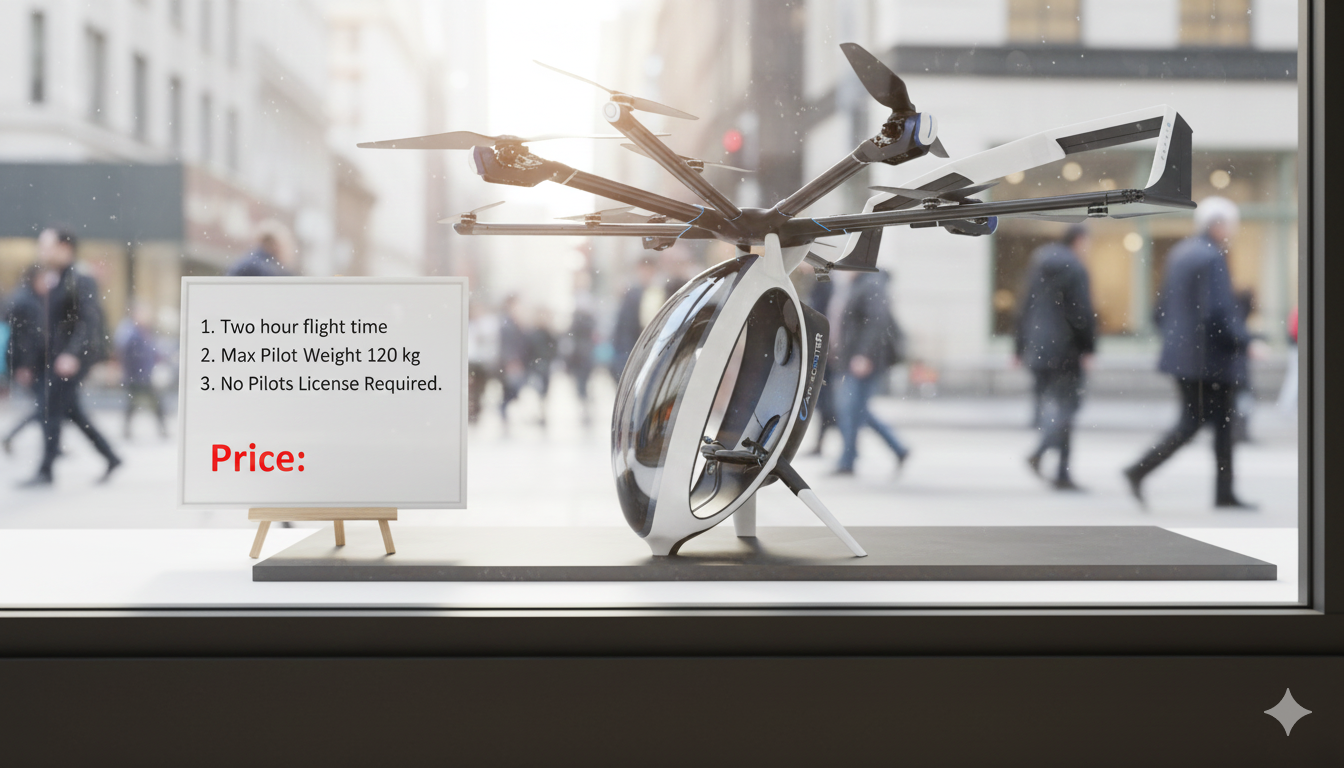
Personal aviation has seen a surge of innovation in recent years—but few aircraft challenge conventions quite like the Zapata AirScooter. With a claimed two-hour flight time, significantly higher payload capacity, and no pilot’s license requirement under ultralight regulations, it raises an important question:
Is this the first truly practical personal VTOL aircraft?
To answer that, we need to look not only at what the AirScooter promises—but how it delivers.
Addressing the Biggest Complaints in Personal VTOLs
In recent weeks, we’ve reviewed several personal eVTOL aircraft, including the Jetson One and a number of its Chinese counterparts. While these vehicles impressed with their agility and design, viewer feedback highlighted two consistent concerns:
1. Limited Flight Time
Typical endurance of 15–20 minutes left many people disappointed. While that’s perfectly reasonable for what are essentially “go-karts of the sky,” it falls short for anyone seeking meaningful range or exploration.
2. Restrictive Weight Limits
Maximum pilot weights often hover around 85–90 kilograms, which many—especially in the U.S.—found uncomfortably limiting for a recreational aircraft.
Then came an answer from France.
Enter the Zapata AirScooter
The Zapata AirScooter appears to check nearly every box enthusiasts have been asking for:
- Up to two hours of flight time
- Maximum pilot weight of 120 kg
- Compact enough for a standard garage
- No pilot’s license required (ultralight category)
On paper, it already stands apart.
Familiar Layout—With a Twist
At first glance, the AirScooter looks familiar. Its multicopter configuration resembles aircraft like the HEXA and Volocopter—multiple propellers, vertical takeoff and landing, and computer-assisted stability designed for simplicity and safety.
But this is where the similarities end.
The AirScooter hides a fundamentally different propulsion philosophy—one rooted in its creator’s long-standing obsession with jet power.
The Mind Behind the Machine: Franky Zapata
Innovation is nothing new for Franky Zapata.
He first captured global attention with the Flyboard, a water-powered platform that let riders hover above lakes and oceans. That success led to the now-iconic Flyboard Air—a jet-powered flying platform that famously raced a Lamborghini across the desert.
Unlike many designers, Zapata personally flew—and risked—his inventions. Over years of testing, crashing, refining, and demonstrating, he developed deep expertise in micro-turbine jet propulsion. He even experimented with turbine-powered seated platforms—early flying-car concepts that were ahead of their time but plagued by noise challenges.
All of that hard-earned experience ultimately fed into a far more mature idea: the AirScooter.
Designed for Real Users, Not Just Viral Videos
Unlike earlier projects, the AirScooter was never meant as a spectacle. It was engineered specifically for U.S. recreational pilots, with an emphasis on:
- Longer endurance
- Higher payload capacity
- Minimal regulatory barriers
This time, practicality came first.
AirScooter Design and Specifications
The AirScooter features a carbon-fiber composite body, an egg-shaped open cockpit, and fixed tricycle landing gear. Flight is fully fly-by-wire, with computer-assisted controls handling stabilization and safety.
- Empty weight: ~115 kg
- Cockpit: Open, panoramic, immersive
- Landing gear: Fixed tricycle
But propulsion is where the aircraft truly becomes unique.
A Hybrid Propulsion System Like No Other
The AirScooter uses 14 propellers mounted on four booms, broken down as follows:
- 4 large propellers (~1 meter diameter)
- 8 smaller electric propellers for lift and stabilization
- 2 dedicated yaw-control propellers
The four large propellers are driven by custom micro-turbine jet engines, developed in partnership with ONERA and the French Defense Innovation Agency.
These turbines run on kerosene, and here’s the key innovation:
A portion of turbine power is diverted to alternators, generating electricity that powers the eight smaller electric propellers.
The aircraft carries roughly five gallons of fuel, along with a battery that acts as an energy buffer—creating a hybrid system that combines the endurance of fuel with the precision of electric propulsion.
Stability, Control, and a Real-World Test
Early AirScooter concepts used a twin-boom tail for directional stability, similar to recent design updates seen on Volocopter’s aircraft. That approach was ultimately replaced by active yaw control via twin electric motors, reducing complexity while improving responsiveness.
In the summer of 2025, Zapata attempted to demonstrate the AirScooter’s range by flying across the English Channel. About a quarter of the way across, an engine failure forced the aircraft into the water. Both pilot and aircraft were safely recovered.
Crucially, the team openly shared footage of the incident—acknowledging the failure and emphasizing that discovering such issues before public release was exactly the point of testing.
Why the AirScooter’s Endurance Matters
The secret behind the AirScooter’s two-hour flight time isn’t magic—it’s micro-turbine jets.
This hybrid architecture offers dramatically greater range than battery-only multicopters, while retaining the compact footprint and vertical takeoff advantages that make personal VTOLs appealing in the first place.
Flying Experience and Price
The AirScooter feels unusually immersive and approachable. The open cockpit provides an unobstructed view without making the pilot feel exposed, and the propellers are positioned far enough away to avoid visual or psychological overload.
Price: approximately $250,000 USD
That’s undeniably steep—but it buys something no other personal VTOL currently offers:
True endurance, meaningful payload capacity, and a realistic path toward everyday recreational flight.
Final Thoughts
The Zapata AirScooter may not be perfect—but it represents a major philosophical shift in personal aviation. By blending jet power with electric precision, it challenges the assumption that short flight times are inevitable.
If the remaining engineering hurdles are solved, this could be the first personal VTOL that truly earns the word aircraft rather than toy.