
One of the quieter surprises at CES 2026 came from Rictor, which unveiled its new X4 personal eVTOL with an eye-catching launch price of $39,900 and deliveries promised as early as Q2 2026.
Yes—the design is unmistakably a copy of the Jetson One, and it now joins a rapidly growing wave of budget personal eVTOLs emerging from China. With pricing dipping below the $40,000 mark, the X4 significantly undercuts many Western offerings. But that’s not the most interesting part of Rictor’s story.
The real intrigue lies in another aircraft the company revealed a year earlier.
The Skyrider X1: A Scooter That Flies
Back at CES 2025, Rictor showcased what was arguably a far more compelling and practical concept: the Skyrider X1.
What made the Skyrider X1 stand out wasn’t just its design—it was the company behind it. Rictor is primarily known as an electric bike and scooter manufacturer. Transitioning from e-scooters to selling eVTOL aircraft in the span of a single year is a massive leap, particularly for a company without a known aviation background.
That naturally raises questions about certification, testing, and product maturity. Still, it’s also possible Rictor had been developing the concept quietly in stealth mode long before its public debut.
Design and Specifications
The Skyrider X1 was effectively a hybrid between an electric scooter and a multirotor aircraft, designed to drive when possible and fly when needed. The announced price was $60,000 USD.
Key design features included four retractable coaxial rotors, similar to many personal eVTOL layouts, along with foldable landing gear to assist with vertical takeoff and landing.
Rictor announced two battery variants: one with a 10.5 kWh battery and another with a 21 kWh battery.
The listed payload capacity was 100 kg, with claimed flight times of 25 minutes for the smaller battery and 40 minutes for the larger one. No official weight or dimensional data was ever released, making it difficult to independently evaluate the realism of these performance claims. Basic physics suggests rotor diameters would likely need to be at least 1.5 meters to lift a rider and battery pack.
Why the Concept Makes Sense
From a design standpoint, pairing an e-bike-scale platform with an eVTOL system makes far more sense than attaching rotors to a full-sized car. The lower base weight dramatically improves efficiency and feasibility.
For anyone who grew up in the 1980s, the Skyrider X1 evokes Condor from the cartoon M.A.S.K.—a transforming motorcycle-helicopter hybrid. In many ways, this is the closest real-world equivalent we’ve seen so far, which is part of what makes the concept so fascinating.
Silence, Then the Skyrider X6
After CES 2025, news on the Skyrider X1 largely went quiet. A single video surfaced showing a partially completed prototype undergoing basic testing, but beyond that, updates have been scarce.
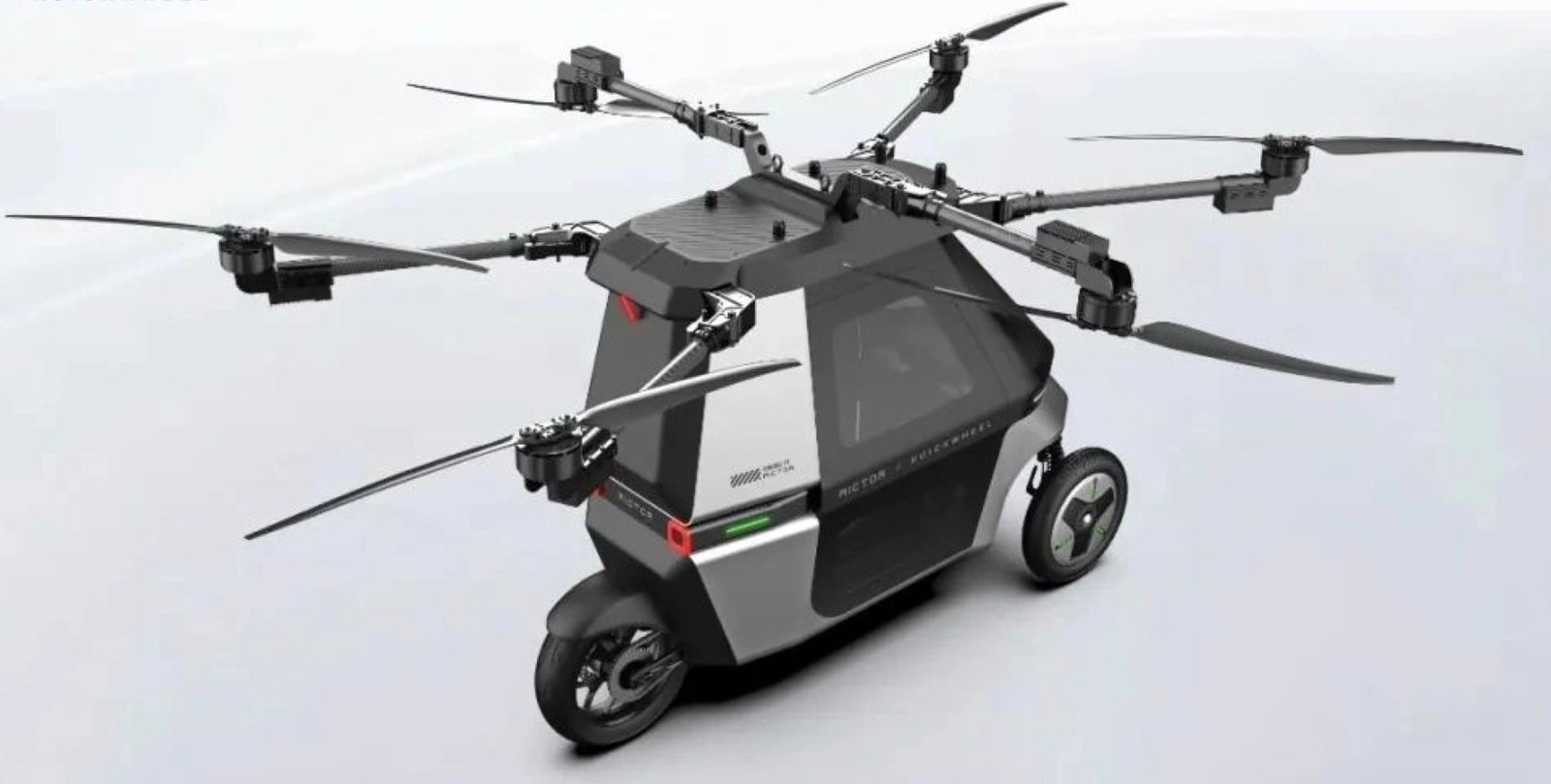
Later, Rictor announced another variant—the Skyrider X6—positioned as a production model under the KuickWheel branding. This version switched to six propellers instead of four coaxial rotors, which in theory could improve efficiency. Rictor also ditched the retractable landing gear in favor of a fixed tricycle layout, likely reducing complexity and weight.
The Skyrider X6 was priced at $69,000 USD, with limited specifications disclosed, including a 20-minute flight time and a top speed of 70 km/h. Beyond that, details remain minimal.
Concept or Commitment?
Whether Rictor’s flying vehicles represent serious long-term development programs or simply eye-catching concepts designed to generate buzz at events like CES remains unclear.
Still, the underlying idea deserves attention. Merging a Jetson One–style aircraft with an ultralight e-bike platform, stripped down to the simplest and lightest possible configuration, opens up a genuinely exciting design space. It’s adventurous, unconventional, and arguably more plausible than many car-based flying concepts.
If nothing else, Rictor has helped push that conversation forward—and that alone makes the Skyrider projects worth watching.