
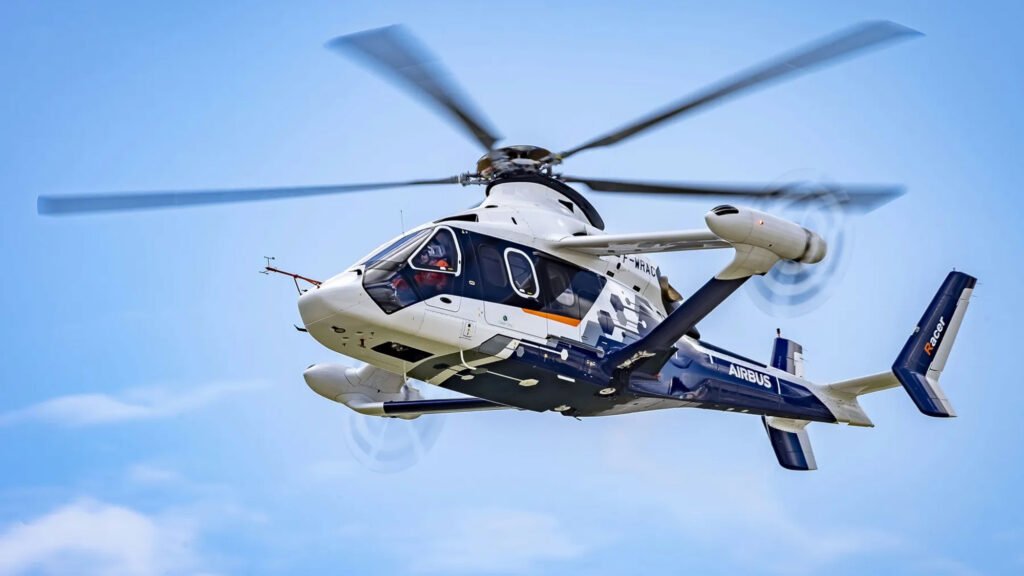
In April 2025, a helicopter reached a speed of 444 kilometers per hour (240 knots). Not through sheer engine power, but by fundamentally rethinking how a rotorcraft should be designed.
That aircraft was Airbus RACER—short for Rapid And Cost-Effective Rotorcraft. In this article, we’ll examine the technologies that enabled this achievement, explore how RACER solves long-standing helicopter performance problems, and consider whether its design philosophy could influence future eVTOL and personal air mobility aircraft.
The Longstanding Challenge of Compound Aircraft
For decades, aerospace engineers have pursued a difficult goal: an aircraft that can take off and land vertically like a helicopter, yet cruise at airplane speeds with fixed-wing efficiency and range.
Many compound aircraft concepts have emerged over the years—including the Autogiro, Fairey Rotodyne, Sikorsky S-72 RSRA, and Kamov Ka-52—but few achieved true operational success.
The most notable exception is the V-22 Osprey. While it meets the performance targets, it does so with extreme mechanical complexity, high cost, and maintenance burdens. In practice, the V-22 behaves more like an airplane that can hover than a helicopter that can fly fast.
This left a gap: could a helicopter-dominant configuration reach high speed efficiently?
From X3 to RACER: A New Generation of Compound Helicopter
In the past decade, Airbus (formerly Eurocopter) began revisiting this challenge. Experimental platforms like the Eurocopter X3 demonstrated that helicopters could exceed traditional speed limits using wings and lateral propulsion.
The RACER builds directly on this lineage—but refines it into a practical, efficient aircraft aimed at real-world operations.
On 24 April 2025, RACER reached 444 km/h, an extraordinary speed for a rotorcraft carrying 10 passengers plus two pilots. While not the fastest helicopter ever built, RACER stands out for something arguably more important: exceptional aerodynamic efficiency.
Ultra-Low Drag: The Foundation of RACER’s Performance
One of RACER’s most impressive achievements is its aerodynamic drag, which is 2.5 times lower than that of a conventional helicopter of similar weight.
This reduction comes from several carefully engineered features:
1. Streamlined Fuselage Design
The fuselage is narrow and smoothly contoured, with wings blended seamlessly into the body rather than abruptly attached. Tail structures align cleanly with airflow, and the fuselage gradually tapers into the boom with no sudden cross-section changes.
2. Fully Faired Main Rotor Hub
Unlike typical exposed rotor hubs—which generate extreme turbulence—RACER’s hub is fully faired. Airbus extended fairings not only between the fuselage and hub, but also around the blade roots, significantly reducing drag and interference.
3. Integrated Lateral Pusher Propellers
Two side-mounted propellers are integrated into a distinctive box-wing configuration, contributing both propulsion and aerodynamic efficiency rather than acting as add-ons.
Designed for High-Speed Efficiency, Not Just Speed Records
RACER is optimized for cruise speeds above 400 km/h (216 knots)—roughly 50% faster than a conventional helicopter.
At 180 knots, RACER achieves:
- 15% lower fuel burn per distance compared to a standard helicopter flying at 130 knots
- A projected 25% reduction in operating cost per kilometer
Speed alone isn’t the goal—efficiency at speed is.
A “More-Electric” Powertrain, Not Hybrid Propulsion
A key contributor to RACER’s efficiency is its Eco-Mode powertrain architecture.
While often described as hybrid-electric, this term can be misleading. The propellers are not electrically driven. Instead, RACER uses a high-voltage DC starter-generator integrated into the drivetrain.
This system allows:
- One turboshaft engine to shut down during cruise
- Restart of the dormant engine within five seconds when full power is needed
Electric power enables smarter energy management—but does not provide propulsion. RACER is best classified as “more-electric,” not hybrid-electric.
No Tail Rotor: Anti-Torque by Design
One of RACER’s most unusual features is the absence of a tail rotor.
Instead, anti-torque is generated through asymmetric thrust from the two lateral pusher propellers. Each propeller independently adjusts pitch to balance main-rotor torque. Power is transmitted mechanically from the main gearbox via shafts and gear trains—an area that could eventually be simplified using electric propulsion.
Hover Anti-Torque Without Prop Wash
In hover, when lateral thrust is minimal, RACER relies on its asymmetric tail boom. The boom has an airfoil-shaped cross-section designed to produce side force from rotor downwash, generating passive anti-torque and reducing reliance on active systems.
Optimized Tail for High-Speed Flight
The RACER tail features an H-shaped empennage with double-curvature vertical stabilizers. This design:
- Reduces drag at cruise speeds
- Minimizes interference with the main rotor wake
- Improves stability without adding unnecessary complexity
Every element reflects an efficiency-driven approach.
The Genius of the Box Wing
Compound helicopters traditionally struggle with rotor downwash interacting with wings, which creates negative lift. For this reason, wings are usually kept small—limiting their usefulness.
Airbus solved this problem elegantly.
The box wing not only provides structural stiffness and mounting points for the propellers, but crucially shields the lower wing from rotor downwash. This allows:
- More lift from a smaller wing area
- Significant unloading of the main rotor
- Lower rotor RPM
Reducing rotor speed cuts both parasitic drag and retreating blade stall, two major barriers to helicopter high-speed flight.
How RACER Improves on the X3
While RACER borrows heavily from the Eurocopter X3, there are critical differences:
- RACER uses box wings, while the X3 did not
- RACER’s lateral propellers are in a pusher configuration, which proved more efficient than the X3’s puller setup
RACER may not chase absolute speed records, but it achieves high speed more efficiently than any helicopter before it.
What RACER Means for eVTOL and Personal Aircraft
Could RACER’s design philosophy influence future eVTOL aircraft?
Absolutely.
- Jaunt’s ROSA closely follows the RACER template and is considered among the safest air taxi designs due to its ability to autorotate during power loss
- Kawasaki produced a cargo drone using a similar configuration years earlier
- Smaller recreational aircraft—such as the Jetson One—could benefit from main-rotor lift combined with lateral cruise propulsion
- Electric rotorcraft like the FlyNow eCopter, already highly efficient, could extend range further by incorporating box wings and lateral props
The RACER demonstrates that helicopter-based designs still have enormous untapped potential—even in an electric future.
Conclusion
The Airbus RACER proves that helicopters don’t need brute-force power or tilt-rotor complexity to reach high speeds. Through careful aerodynamic optimization, clever torque management, and intelligent system integration, RACER represents a major step forward in rotorcraft efficiency.
Whether its concepts shape future eVTOLs or simply redefine what helicopters can be, one thing is clear: RACER has changed the conversation.