
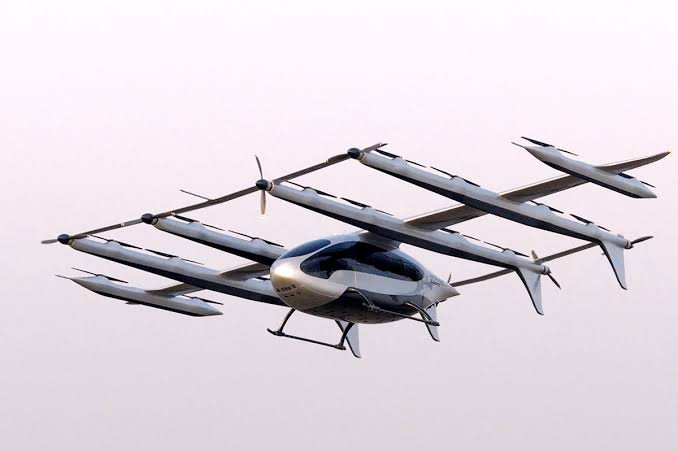
AutoFlight is emerging as one of the most ambitious players in the electric aviation sector. With its enormous 5.5-tonne Matrix eVTOL, spectacular autonomous formation flights and a strategic partnership with battery giant CATL, the company is pushing the boundaries of what electric aircraft can achieve.
But perhaps the most interesting development is happening behind the scenes. CATL has been developing aviation batteries with energy densities reaching 500 Wh/kg, almost double those of conventional high-performance lithium-ion cells.
Could this battery technology explain how AutoFlight has managed to develop an eVTOL that is considerably larger than its competitors?
Five eVTOLs Take to the Skies in a Spectacular Formation Flight
On November 1, 2026, five electric VTOL aircraft rose from the shores of Bailian Lake despite windy conditions. For the next 47 minutes, they performed a spectacular display of coordinated formation flying.
Formation flying traditionally requires extraordinary pilot skill, with aircraft maintaining precise positions relative to one another. What made this demonstration remarkable was that the entire formation flight was autonomous.
The aircraft followed predetermined flight routines while coordinating their movements to maintain formation. It offered a glimpse into a future where multiple autonomous electric aircraft could operate together in increasingly busy airspace.
However, the formation flight also showcased something particularly interesting about AutoFlight’s expanding aircraft portfolio.
Among the five aircraft were three different types: the certified CarryAll cargo aircraft, a firefighting variant based on the V2000 platform, and the centrepiece of the demonstration, the Matrix, also designated the V5000 Sky Dragon.
The Matrix: A 5.5-Tonne eVTOL That Changes the Rules
<text></text>
The <text></text>AutoFlight Matrix represents a significant departure from the relatively small air taxis currently being developed around the world.
Most prominent electric air taxi programmes, including those of Joby Aviation, Archer Aviation and Vertical Aerospace, have focused on aircraft with maximum take-off weights generally ranging between 2,000 and 3,000 kg.
The Matrix, however, takes this concept to an entirely different scale.
With a maximum take-off weight of approximately 5,500 kg, it is among the largest eVTOL aircraft currently under development. It can accommodate up to 10 people, opening the possibility of applications beyond conventional air taxi services, including corporate transport and private aviation.
The aircraft even features a toilet, something rarely encountered in the emerging eVTOL market.
Its headline specifications are equally impressive.
| Specification | AutoFlight Matrix |
|---|---|
| Maximum take-off weight | 5,500 kg |
| Passenger capacity | Up to 10 people |
| Maximum payload | 1,500 kg |
| Pure-electric range | 250 km (155 miles) |
| Maximum speed | 280 km/h (174 mph) |
| Lift rotors | 20 |
| Configuration | Lift-plus-cruise |
These specifications put the Matrix in a different category from many of the electric air taxis currently being developed.
A Familiar Configuration on a Much Larger Scale
Despite its enormous size, the Matrix borrows much of its design philosophy from AutoFlight’s earlier Prosperity platform.
It uses a lift-plus-cruise configuration, eliminating the mechanical complexities associated with tilting rotors or wings.
The aircraft features 20 dedicated lift rotors for vertical take-off and landing, alongside a distinctive push-pull arrangement for forward propulsion.
Its latest-generation electric motors also reportedly offer approximately 20% greater power density than the previous generation.
But perhaps the most interesting aspect of the Matrix is its battery technology.
CATL and AutoFlight: A Partnership That Could Change Everything
In August 2024, AutoFlight signed a strategic investment and cooperation agreement with CATL, the Chinese battery giant and the world’s leading electric vehicle battery manufacturer.
CATL has been the world’s largest EV battery manufacturer for nine consecutive years, accounting for approximately 40% of the global EV battery market.
However, CATL’s ambitions extend beyond electric vehicles.
In April 2023, the company unveiled its revolutionary Condensed Battery technology, with a claimed energy density of up to 500 Wh/kg at the single-cell level.
This represented a significant technological development.
For comparison, mainstream premium electric vehicle batteries commonly use cells with specific energies of approximately 250–300 Wh/kg. CATL’s announced figure therefore represented a potential improvement of around 67–100%.
The company also indicated that its aviation battery technology had progressed into aircraft applications, with reports of a four-tonne-class aircraft being flown using the technology.
When AutoFlight unveiled the Matrix in 2026, the possibility that CATL’s advanced battery technology might be involved naturally raised an interesting question.
Could the Matrix be using CATL’s 500 Wh/kg Condensed Battery?
At present, AutoFlight has not publicly confirmed that the Matrix uses these particular cells.
However, there is other information suggesting that the company is working with battery technology that could offer a substantial advantage over its competitors.
How Does AutoFlight’s Battery Compare with Joby, Archer and Vertical Aerospace?
To appreciate the potential significance of AutoFlight’s battery technology, it is worth examining the cells currently associated with some of the leading electric air taxi manufacturers.
One important distinction is between cell-level and pack-level energy density.
An individual battery cell may have a specific energy of 250 Wh/kg, but once integrated into a battery pack, the overall energy density decreases.
This is because the pack contains additional components, including structural enclosures, electrical connections, busbars, battery management electronics and thermal management systems. These components increase the total mass without contributing directly to the energy stored.
The following table provides an indicative comparison of battery technologies associated with some leading electric aircraft programmes.
| Manufacturer | Cell-level specific energy | Pack-level specific energy |
|---|---|---|
| Joby Aviation | 288 Wh/kg | 235 Wh/kg |
| Archer Aviation | ~235 Wh/kg | ~200 Wh/kg |
| Vertical Aerospace | 242 Wh/kg | ~200 Wh/kg |
| Beta Technologies | 288 Wh/kg | 235 Wh/kg |
| AutoFlight (cell under testing) | 350 Wh/kg | Not disclosed |
| CATL Condensed Battery | Up to 500 Wh/kg | Not disclosed |
Note: Figures include reported specifications and estimates. They are not necessarily independently verified production-pack values. The CATL Condensed Battery figure is a cell-level technology claim, not a confirmed specification for the Matrix.
Joby Aviation has reported cells with an energy density of approximately 288 Wh/kg and battery packs achieving around 235 Wh/kg.
Archer Aviation uses Molicel P45B 21700 cylindrical lithium-ion cells, with cell-level specific energy estimates around 235 Wh/kg and estimated pack-level energy density around 200 Wh/kg.
Vertical Aerospace also uses Molicel P45B cylindrical cells, which have a nominal specific energy of approximately 242 Wh/kg. Its pack-level specific energy has been estimated at around 200 Wh/kg.
Beta Technologies has also been associated with high-energy cylindrical lithium-ion cells, with reported figures of approximately 288 Wh/kg at the cell level and 235 Wh/kg at the pack level.
These figures illustrate the limitations that aircraft manufacturers must overcome when designing electric propulsion systems.
AutoFlight’s 350 Wh/kg Cell: A Potential Competitive Advantage
Although AutoFlight has not confirmed the use of CATL’s 500 Wh/kg Condensed Battery in the Matrix, the company has disclosed testing battery cells with a specific energy of 350 Wh/kg in the context of thermal propagation.
Even this figure is significant.
Compared with a conventional high-energy cell rated at 250 Wh/kg, it represents a 40% improvement in specific energy.
Compared with a 288 Wh/kg cell, the improvement is approximately 22%.
For electric aircraft, where battery mass is a major constraint, such improvements can have a substantial impact on aircraft design.
Higher cell-level energy density can potentially allow manufacturers to increase the amount of energy carried without a proportional increase in battery mass.
Alternatively, it can enable the same energy capacity to be achieved with a lighter battery, freeing up weight for passengers, cargo or other aircraft systems.
However, there is an important qualification.
A 40% improvement in cell-level specific energy does not automatically translate into a 40% improvement at the battery pack level. The final result depends on packaging efficiency, thermal management, electrical architecture and safety requirements.
In particular, thermal propagation protection is a critical consideration for aviation batteries, where preventing a failure in one cell from spreading throughout the battery pack is essential.
Nevertheless, if AutoFlight can translate a substantial proportion of its cell-level advantage into a practical aviation battery pack, it could help explain the Matrix’s impressive combination of payload, range and aircraft size.
And with CATL as a strategic partner, AutoFlight may have access to battery development capabilities that could prove increasingly important as the electric aviation market matures.
Building Operational Experience Through CarryAll
Battery technology is only one part of the challenge. Electric aircraft manufacturers must also demonstrate reliability, safety and operational performance.
AutoFlight has been building valuable real-world experience through its CarryAll cargo aircraft.
In 2025, the company conducted a 58-minute maritime flight, successfully landing on an offshore oil and gas platform approximately 150 kilometres from the Shenzhen coastline.
The equivalent supply journey by boat reportedly takes around 10 hours.
Such flights demonstrate the potential advantages of electric aviation in offshore logistics, where conventional transport can be slow and expensive.
They also provide AutoFlight with operational experience involving its aircraft, propulsion systems and batteries under real-world conditions.
Alongside these activities, AutoFlight is pursuing EASA certification and has established a presence in Germany.
Achieving European certification would represent a major milestone, potentially opening access to significant international markets.
Has AutoFlight Laid Down the Gauntlet?
AutoFlight’s recent autonomous formation flight demonstrated more than the ability to coordinate multiple electric aircraft.
It showcased a company developing aircraft across several categories, from cargo transport and firefighting to large passenger-carrying eVTOLs.
The Matrix, in particular, represents a substantial step beyond the scale of conventional electric air taxis.
But its most important advantage may not be immediately visible.
While several competitors rely on high-performance lithium-ion cells originally developed for broader applications, AutoFlight has a strategic relationship with a battery manufacturer actively pursuing aviation-specific cell technology.
CATL’s announced 500 Wh/kg Condensed Battery remains an intriguing possibility, although its use in the Matrix has not been confirmed.
Even the 350 Wh/kg cell technology disclosed in AutoFlight’s testing suggests that the company is exploring battery performance beyond that commonly associated with current electric air taxis.
If this technological advantage can be translated into reliable, certifiable battery packs, it could give AutoFlight a significant competitive edge.
Perhaps the real secret behind the Matrix is not its enormous size or its 20 lift rotors, but the battery technology that could make such an aircraft practical.