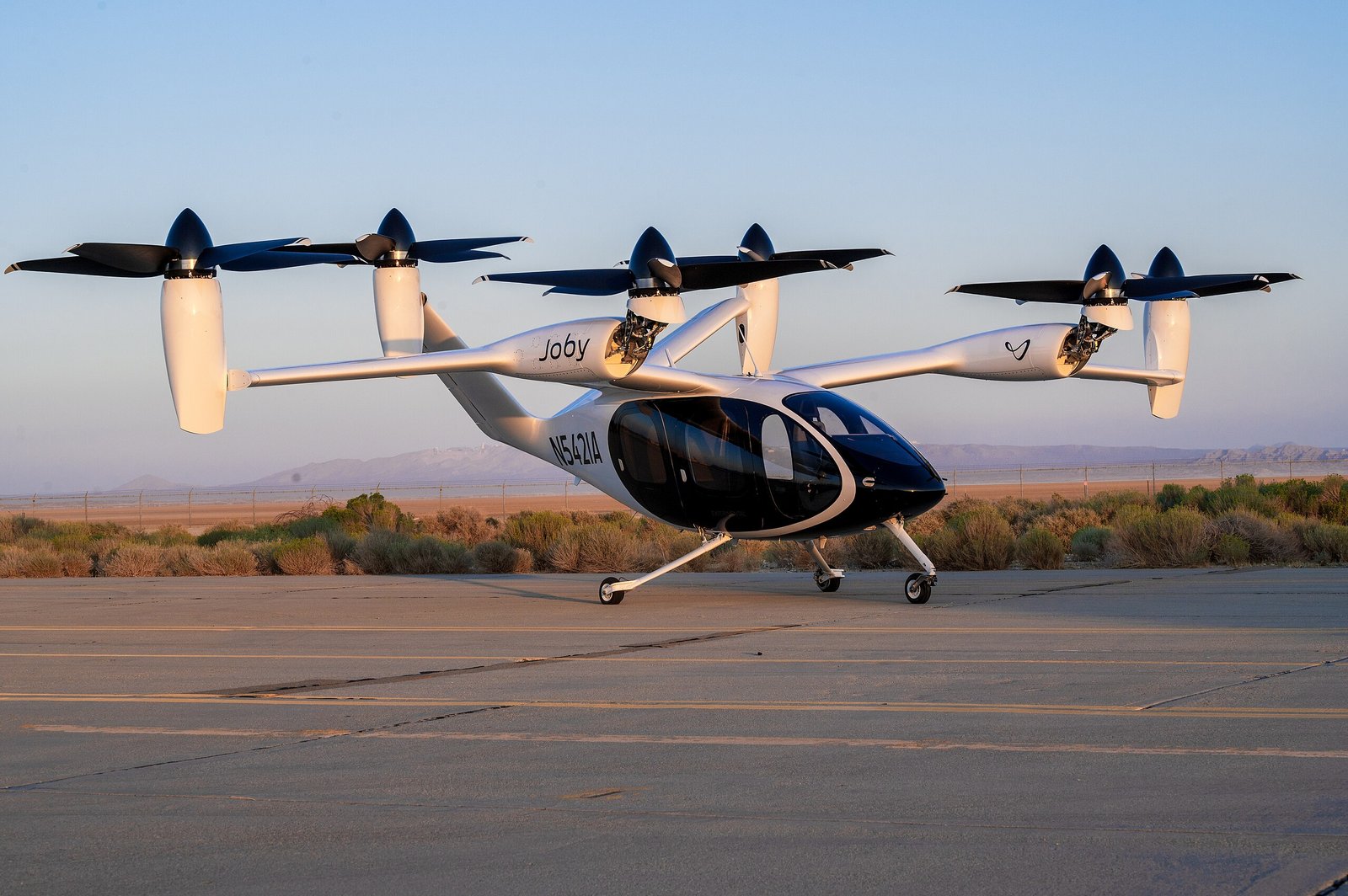
| Tilt-rotor / tilt-prop configuration with mixed placement | The S4 has six tilting electric propellers: four mounted on the wings, two on its V-tail. Some propellers tilt via the motor nacelle, others via linkages. This mixed tilt mechanism allows more optimal transition between hover and forward flight. |
| Hybrid characteristics: rotorcraft + winged airplane | It operates like a rotorcraft for vertical take-off/landing, and like a fixed-wing airplane in cruise, with the wings and control surfaces (ailerons/flaps) contributing to lift. This gives better efficiency in forward flight vs pure VTOL designs. |
| High redundancy & safety features | Dual-wound motors, dual redundant inverters, multiple battery packs, etc., plus redundancy in critical subsystems. It also has to meet special airworthiness criteria under FAA “powered-lift” category. This ensures higher safety margins. |
| Noise reduction / low acoustic signature | In cruise, noise is very low (~45 dBA in one estimate), claimed to be much quieter than helicopters. Useful for urban operations with strict limits on noise. |
| Simplified Vehicle Operations (SVO) | Designed to reduce pilot workload by integrating flight control systems, smoothing transitions between vertical and forward flight, making operations simpler. This is important for safety, certification, and operational cost. |
| High performance in speed + range for eVTOL | With cruise speeds up to ~200 mph (≈322 km/h) and range up to ~100 miles (~160-150 sm depending on source), it pushes higher than many VTOL designs in the speed-range trade-off. |
| Certification under “special class / powered-lift” category | Joby’s JAS4-1 is being certified under FAA’s special airworthiness criteria for a powered-lift aircraft — defining rules combining airplane & rotorcraft standards. That’s fairly novel. |
| Composite materials, lightweight design | Many components, including propellers and structure, are composite materials, optimizing weight vs strength. Combined with advanced battery tech that has relatively high Wh/kg (energy density) helps performance. |
| Large windows / cabin experience | The design includes large windows so passengers get panoramic views, improving user experience, which is an important consideration for air-taxi style operations. |

[…] Joby S4: ~450 kg […]